
Good rap lyrics sound effortless, but they aren't. Behind every verse that hits there's a clear idea, a rhyme pattern the ear can follow, lines that fit the beat, and a hook people remember after one listen. You can learn all of that, step by step.
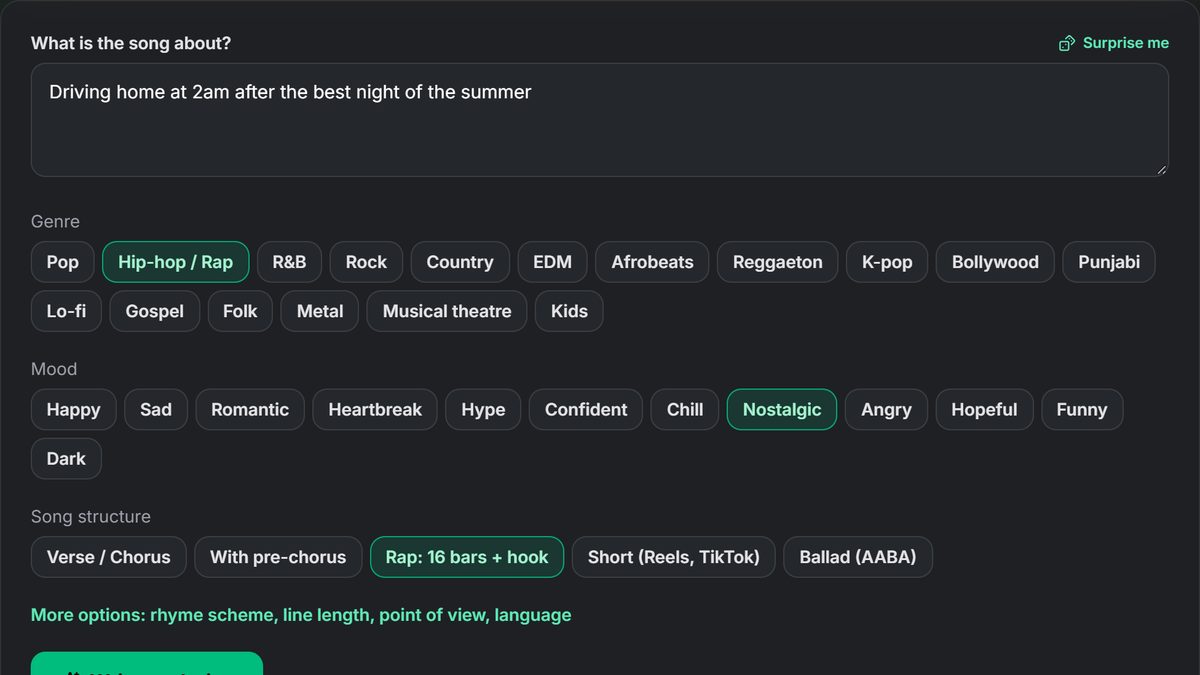
This guide shows you how to write rap lyrics from a blank page: picking a concept, writing bars, counting syllables, building multi-syllable rhymes, controlling your flow and writing a hook. Every step has examples, and you can try each one in the free AI Lyrics Generator, which counts the syllables in every line and colours the rhymes so you can see your rhyme scheme.
How to write rap lyrics, in short
- Pick one idea for the song and say it in a sentence.
- Write the hook first: 4–8 short lines built around one repeatable phrase.
- Write a 16-bar verse: one bar is one line, about 8–16 syllables at most tempos.
- Rhyme in pairs or fours (AABB), then add multi-syllable and internal rhymes.
- Count syllables so lines that sit next to each other are close in length.
- Rap it over the beat, cut what trips you up, and rewrite the weakest bar.
Step 1: Start with one clear idea
The most common reason a verse feels weak isn't the rhymes. It's that the verse is about nothing in particular. Before you write a single bar, finish this sentence: "This song is about…"
Strong ideas are specific:
- "Driving home at 2am after the best night of the summer, knowing it won't happen again."
- "My mum worked two jobs so I could have one dream."
- "Everyone who doubted me is asking for tickets now."
Weak ideas are general: "success", "love", "the struggle". They aren't wrong, but they don't give you anything to describe. A specific idea hands you images (the empty road, the dashboard light, the last song on the playlist), and images are what make bars memorable.
Tip: write down 10 concrete details about your idea before you start: places, objects, names, times, smells, things people said. You'll use them as raw material.
Step 2: Learn the structure of a rap song
Most rap songs follow the same frame. Knowing it means you always know what you're writing and how long it should be.
| Part | Length | Job |
|---|---|---|
| Intro | 2–4 bars (optional) | Sets the mood; often ad-libs or a spoken line |
| Verse 1 | 16 bars | Tells the story or makes the argument |
| Hook (chorus) | 8 bars (often 4 lines, each repeated) | The part everyone remembers |
| Verse 2 | 16 bars | Moves the story forward or flips the angle |
| Hook | 8 bars | Same as before |
| Verse 3 or bridge | 8–16 bars (optional) | A twist, a resolution or a change of energy |
| Outro | 2–8 bars (optional) | Hook repeat, fade or a final line |
A bar is one measure of music: four beats. In rap, one bar usually equals one line of lyrics. So a "16" is a 16-line verse.
Short-form songs for TikTok and Reels are different: they need a hook within the first few seconds, and often the whole thing is just a hook and 8 bars. In the AI Lyrics Generator, the Short (Reels, TikTok) structure writes exactly that.
Step 3: Write the hook first
It feels backwards, but writing the hook first is how a lot of songwriters work, because the hook is what the song is for. Once you have it, every verse has a destination.
A good hook:
- Repeats one phrase (the title, usually) at least twice.
- Uses simple words. Save the complex wordplay for the verses.
- Has a different rhythm from the verses: slower, more melodic or more chant-like.
- Says the idea of the song in the fewest words possible.
Example hook for the "2am drive" idea:
Windows down at two, we ain't going home yet Summer in the rearview, best night I won't forget Windows down at two, let the city fade out If this is the last time, turn the radio loud
Notice: the phrase "Windows down at two" opens lines 1 and 3, the line endings rhyme in pairs (yet / forget, out / loud is a near rhyme), and every line is short enough to sing or chant.
Step 4: Write bars that fit the beat
This is where most beginners struggle: lines that read well on paper but are too long or too short to rap.
How many syllables fit in a bar?
It depends on tempo and on how fast you rap. As a rough guide at common hip-hop tempos:
| Style | Typical tempo | Syllables per bar |
|---|---|---|
| Laid-back / boom bap | 85–95 BPM | 10–14 |
| Trap (half-time feel) | 130–150 BPM | 8–14 |
| Drill | 140–145 BPM | 10–16 |
| Fast / double-time | any | 16–24+ |
You don't need every line to have the same count. You need neighbouring lines to be close, especially lines that rhyme with each other. If line 1 has 11 syllables and line 2 has 19, line 2 will feel rushed.
Count syllables automatically
Counting by hand is slow. The AI Lyrics Generator shows a syllable count next to every line, so you can spot the line that's 6 syllables longer than its partner and trim it. Press Check my own lyrics to paste a verse you wrote yourself: you get the same syllable counts and rhyme colours, no account needed.
Step 5: Rhyme like a rapper, not like a nursery rhyme
Rhyme is what makes rap sound like rap. There are four levels to learn.
1. End rhymes
The last words of two lines rhyme: night / light. It's the foundation, but single-syllable end rhymes on their own sound basic.
2. Rhyme schemes
The pattern your end rhymes make, labelled with letters:
- AABB (couplets): lines 1–2 rhyme, lines 3–4 rhyme. The most common scheme in rap. Easy to follow, strong forward drive.
- ABAB: lines 1 and 3 rhyme, lines 2 and 4 rhyme. More song-like.
- AAAA (mono-rhyme): four or more lines on the same sound. Builds intensity; great before a hook.
- ABCB: only lines 2 and 4 rhyme. Common in hooks and storytelling.
In the AI Lyrics Generator, lines that rhyme with each other share a colour, so your scheme is visible at a glance. Choose a scheme under More options to ask for one specifically, including Multisyllabic for multi-syllable and internal rhymes.
3. Multi-syllable rhymes
Instead of rhyming one syllable, rhyme two, three or four:
- summer nights / runner lights
- going home yet / slowing, no sweat
- rearview mirror / clear through, it's clearer
Multi-syllable rhymes match the vowel sounds of several syllables in a row, even if the consonants differ. That's why "rearview mirror" works with "clear through, it's clearer": the vowels line up.
How to find them: say your last 2–3 syllables out loud, keep only the vowel sounds ("ee-oo-ee-uh"), and look for other words and phrases with the same vowels. Tap the last word of any line in the AI Lyrics Generator and it shows rhymes for it from a rhyme dictionary; the free Rhyme Finder also groups perfect rhymes, near rhymes and sound-alikes.
4. Internal rhymes
Rhymes inside the line, not just at the end:
Late night, headlights, every light green We ain't slowing, we just flowing, no sweat, no regret in between
Internal rhymes are what make a verse feel dense and skilful. Add them in your second draft, once the meaning of each line is settled.
Step 6: Control your flow
Flow is where your syllables land against the beat. Two rappers can say the same words with completely different flows.
Ways to change flow inside a verse:
- Switch speed. Rap 4 bars relaxed, then 2 bars in double time, then back.
- Start lines in different places. Not every line has to start on beat 1. Starting a line early (on the "and" before the beat) or late changes the feel.
- Leave space. A pause before a punchline makes it land harder.
- Stack the rhymes on the snare. Placing a rhyme on beats 2 and 4 (where the snare hits) makes it pop.
Write first, then rap the verse over the beat and adjust. Read-only rap lyrics always need a pass with the beat playing. If you don't have a beat yet, make one in the free Online Beat Maker: pick Trap, Drill or Boom bap, press Play, and rap over the loop.
Step 7: Write the verse (a worked example)
Here's how a verse comes together, using the "2am drive" idea and the details from Step 1.
Bars 1–4: set the scene. Where are we, when, with who?
Two a.m., the city's breathing slow Got the windows cracked, let the cold air flow You were singing every word to a song you didn't know And I swear that I felt seventeen, a decade ago
Bars 5–8: the feeling. Why does this moment matter?
Bars 9–12: the turn. Introduce tension: this won't last, someone's leaving, summer's ending.
Bars 13–16: the punchline into the hook. End the verse on a line that sets up the hook phrase.
Each 4-bar block has one job. That's the secret to verses that don't wander.
Step 8: Edit like a pro
Your first draft is raw material. Then:
- Cut the filler. Words like really, just, like, so, yeah often exist only to fill syllables. Replace them with detail.
- Replace clichés. "Grind", "on top", "hustle", "haters", "rise from the bottom": if you've heard it a thousand times, so has everyone else. Say the same thing with a detail only you would write.
- Strengthen the weakest bar. Every verse has one. Find it and rewrite it.
- Check the rhyme colours. If a block has no colour at all, it probably has no rhymes.
- Rap it out loud, three times. Anything you stumble on twice, rewrite.
In the AI Lyrics Generator, every section has Rewrite and Catchier buttons. Rewrite gives you a fresh version of one section and leaves the rest of the song alone; Catchier makes a hook simpler and more repeatable. Every change can be undone, and you can edit any line by hand.
How to use AI to write rap lyrics (without losing your voice)
AI is useful for rap in three ways:
- Getting unstuck. Type your idea, pick Hip-hop / Rap and Rap: 16 bars + hook, and you get a full first draft in seconds. Keep the lines you like and rewrite the rest.
- Rhyme and structure help. Ask for multi-syllable rhymes, a specific rhyme scheme, or a first-person or third-person story.
- Rewriting single sections. If your hook works but verse 2 doesn't, rewrite only verse 2.
The best results come from specific details: names, places, times and things people said. Put them in Words to include under More options. A prompt like "song about my brother leaving for the army; mention the blue Corolla, Sunday football, mum's kitchen" gives you far better bars than "sad rap about family".
The AI Lyrics Generator is free with a free account (15 songs a day), writes in 76 languages, and avoids the stock phrases that make AI lyrics sound generic. When your lyrics are ready, Hear it sung with AI sends them straight to the AI song maker, which turns them into a full song with vocals.
Common mistakes when writing rap lyrics
- Forcing a rhyme that doesn't make sense. If the line exists only for the rhyme, listeners notice. Change the first line instead, so a natural rhyme becomes possible.
- Every line the same length and rhythm. It gets monotonous. Vary your flow.
- No hook, or a hook that's too complicated. If you can't remember it after one listen, simplify.
- Telling instead of showing. "I was sad" vs "Left his jersey on the chair for a year". Show it.
- Writing without the beat. Always test against the tempo you'll rap on.
Frequently asked questions about writing rap lyrics
How do I start writing rap lyrics as a beginner?
Pick one specific idea, write a 4-line hook around one repeatable phrase, then write a 16-bar verse in AABB couplets. Count syllables so neighbouring lines are close in length, and rap it over a beat to test it.
How many bars are in a rap verse?
Usually 16 bars, which is 16 lines. Shorter verses of 8 or 12 bars are common in features and in short-form songs for TikTok and Reels.
How many syllables should be in a rap bar?
Roughly 8–16 syllables at most hip-hop tempos, and more in double-time flows. Consistency between rhyming lines matters more than the exact number.
What is the most common rhyme scheme in rap?
AABB couplets, where each pair of lines rhymes. Rappers then layer multi-syllable and internal rhymes on top.
What is a multi-syllable rhyme?
A rhyme that matches the vowel sounds of two or more syllables in a row, like "summer nights" and "runner lights". It sounds more skilful than single-syllable rhymes.
Can AI write rap lyrics?
Yes. A good AI lyrics generator can write a full verse and hook from your idea, in a rhyme scheme you choose. It works best as a first draft: keep the strongest bars, add your own details and rewrite the rest so it sounds like you.
Is it free to use the AI Lyrics Generator?
Yes. It's free with a free SongUp AI account, up to 15 songs a day, with a syllable count, rhyme colours, section rewrites and a .txt download.
Who owns lyrics I write with AI?
The lyrics are yours to use, edit and release. As with any lyrics, avoid copying lines from existing songs.
How do I turn my rap lyrics into a song?
Rap them over a beat you made or licensed, or send them to an AI song maker. In the AI Lyrics Generator, Hear it sung with AI opens the SongUp AI song maker with your lyrics already filled in.
The bottom line
Writing rap lyrics is a craft with clear steps: one idea, a hook first, 16-bar verses with a job for each block of four, rhyme schemes you can see, syllable counts that fit the beat, and ruthless editing. Try it now in the free AI Lyrics Generator: write a draft or paste your own, watch the syllables and rhyme colours, rewrite the weak sections, then hear it as a full song.