
A trap beat is built from a handful of parts: a hard 808 that slides between notes, a snare or clap on beat 3, fast rolling hi-hats, and a dark melody on top. Once you know where each part goes, you can make one in about ten minutes, even if you've never made a beat before.
This guide walks through every part of a trap beat, step by step: the tempo, the drum pattern, hi-hat rolls, the 808 and its glide, the melody, the arrangement and the mix. You can follow along in the free Online Beat Maker, which runs in your browser, has a Trap kit with sliding 808s, and exports WAV, MP3 and MIDI.
How to make a trap beat, in short
- Tempo: 130–150 BPM, felt in half time (140 is the classic).
- Drums: clap or snare on beat 3 of every bar; kicks syncopated around it.
- Hi-hats: 8th notes as the base, then rolls of 16ths, 32nds and triplets at the end of phrases.
- 808: a long, distorted sub bass that follows the kick and glides between notes.
- Melody: a short, dark loop in a minor key: bells, piano, plucks or strings.
- Arrange it into intro, hook and verse sections, then mix so the 808 and kick don't fight.
What makes a beat sound like trap?
Trap grew out of Atlanta hip-hop in the 2000s and became one of the most popular styles in the world. Its sound comes from a few specific choices:
- A fast tempo that feels slow. Trap sits around 130–150 BPM, but the snare lands only once per bar (on beat 3), so the groove feels like half that speed. That leaves space for fast hi-hats and for rappers to switch between slow and fast flows.
- The 808. Originally the bass drum of the Roland TR-808 drum machine, tuned low and held long so it works as both kick and bassline.
- Rolling hi-hats. Bursts of rapid hi-hat hits that speed up and slow down.
- Dark, minimal melodies. Minor keys, eerie bells, sparse piano, orchestral strings.
If you get these four right, it will sound like trap.
Step 1: Set the tempo and key
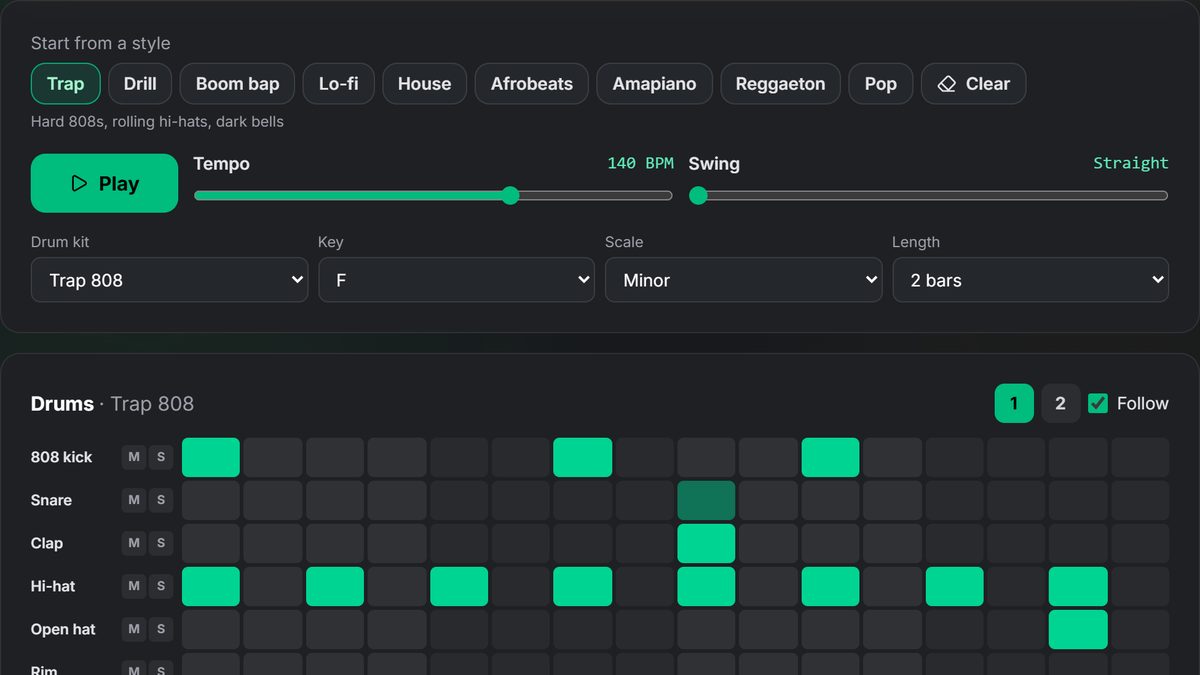
Open the Online Beat Maker and press Trap. That loads a full trap beat at 140 BPM in F minor, which you can play right away and then change part by part. Press Clear if you'd rather start from an empty grid.
Tempo. Common trap tempos:
| Vibe | Tempo |
|---|---|
| Slow, moody trap / trap soul | 120–135 BPM |
| Classic trap | 138–145 BPM |
| Hard, aggressive trap | 145–160 BPM |
Key. Trap is almost always in a minor key. F minor, C minor, G minor and A minor are all common. For an even darker, more exotic sound, try Harmonic minor or Phrygian under Scale. The melody roll in the Beat Maker only shows notes in your chosen key and scale, so you can't hit a wrong note.
Step 2: Program the drums
Trap drums are written on a 16-step grid: each bar has 16 steps, four per beat. Steps 1, 5, 9 and 13 are the four beats.
Snare or clap: beat 3
Put the clap (or snare, or both layered) on step 9 of every bar. That's beat 3, and it's what gives trap its half-time feel. Don't put it on beats 2 and 4 like a normal hip-hop beat.
Kick: syncopated around the clap
The kick lands on beat 1 (step 1), then in places that bounce off the clap. A classic pattern:
Kick:  x . . . . . x . . . x . . . . .
Clap:  . . . . . . . . x . . . . . . .
That's the 808 kick on steps 1, 7 and 11. Vary the second bar slightly (move a kick, add one) so the loop doesn't feel robotic.
In the Beat Maker, tap a step once for a normal hit, tap again for a soft hit (a lighter green), and once more to turn it off. Soft hits are perfect for ghost notes on the snare.
Hi-hats: the 8th-note base
Start with a hi-hat on every other step (steps 1, 3, 5, 7…): straight 8th notes. That's your steady pulse. Add an open hat on the last off-beat of the bar for a small lift into the next bar.
Step 3: Add hi-hat rolls
Hi-hat rolls are the signature of trap. A roll is a short burst of faster hits: 16th notes, 32nd notes or triplets, usually at the end of a phrase or right before the clap.
How to write rolls on a 16-step grid:
- 16th-note roll: fill every step for half a beat or a beat: steps 13, 14, 15, 16.
- Stutter: alternate normal and soft hits in a run so the roll breathes: normal, soft, normal, normal.
- Gaps: remove one hit in the middle of a run. Silence makes rolls more rhythmic.
The Trap preset's second bar ends with a roll like this:
Hat: x . x . x . x . x . x o x o x x
(x = normal hit, o = soft hit.) It speeds up and fades at the same time, leading the ear back to beat 1.
Rule of thumb: keep bars 1 and 3 of a 4-bar phrase simple, and put the busiest rolls in bars 2 and 4. If every bar is full of rolls, none of them stand out.
Step 4: Make the 808 slide
The 808 is the heart of a trap beat. It does two jobs: it's the low end of the kick, and it's the bassline.
Open 808 / Bass in the Beat Maker. You'll see a roll with the notes of your scale, one row per note.
- Follow the kick. Put an 808 note wherever there's a kick. Start on the root (the first note of your key: F in F minor).
- Hold notes long. Trap 808s ring until the next note. In the Beat Maker, the Trap preset's 808 lasts until the next note automatically.
- Change notes on the bar. Move the 808 to the 3rd, 4th, 5th or 6th note of the scale for the second bar. That creates a bassline under the melody.
- Turn on 808 glide. With 808 glide on, back-to-back notes slide into each other: the pitch bends from one note to the next instead of jumping. That slide is the sound of modern trap and drill.
Tip: glides sound best between notes that are far apart (an octave, or root to 5th) and when the second note arrives quickly after the first.
Other bass sounds are one click away: Sub bass (cleaner and rounder), Reese (wide and gritty, for darker beats) and Synth bass.
Step 5: Write a dark melody
Trap melodies are short and repetitive: a 1- or 2-bar phrase that loops. The Trap preset uses Bells, but these all work:
- Bells or Pluck: classic dark, eerie trap.
- Grand piano or Electric piano: sad trap, trap soul.
- Strings: orchestral, cinematic trap and drill.
- Flute: the flute-loop sound that took over trap in the late 2010s.
How to write one:
- Open Melody and choose an instrument.
- Start with 3–5 notes, mostly falling: high, then step down. Falling melodies sound darker.
- Leave space. A melody that plays on every step fights the rapper.
- Copy bar 1 to bar 2, then change only the last two notes. Repetition with a small change is what makes a loop catchy.
Add Chords underneath with a Warm pad holding one chord per bar. The classic trap progression in a minor key is i – VI (in F minor: F minor to D♭ major), which is what the Trap preset uses. i – iv, i – VII – VI and i – VI – III – VII also work.
Step 6: Arrange the beat
A loop isn't a song yet. Rappers and singers need sections that change. Set Length to 4 bars for more room, then build parts:
| Section | Bars | What plays |
|---|---|---|
| Intro | 4–8 | Melody only, or melody and hats |
| Hook | 8–16 | Everything: drums, 808, melody |
| Verse | 16 | Drums and 808; melody quieter or simpler |
| Hook | 8–16 | Everything again |
| Bridge / break | 4–8 | Drop the drums or the 808 |
| Hook / outro | 8–16 | Everything, then strip back |
Use the Mixer to mute parts (M) or hear one alone (S) while you decide what plays where. Export each version as a loop (1×, 2×, 4× or 8×) and line them up in order, or export MIDI and arrange in your DAW.
The drop trick: remove the 808 and kick for the last beat or two before the hook comes in. The silence makes the hook hit much harder.
Step 7: Mix the beat
The most common trap mixing problem: the kick and 808 fight in the low end and the beat sounds muddy or distorted.
- Let the 808 be the bass. If your kick is also very low, the two overlap. Use a punchier, shorter kick, or let the 808 itself be the kick.
- Give the clap room. It should cut through clearly on beat 3. Turn it up before you turn anything else down.
- Hats sit back. Rolling hats are busy; keep them quieter than the clap so they don't tire the ear.
- Melody under the vocal. Leave space in the middle frequencies for a voice.
- Don't clip. If the master is distorting, turn parts down instead of turning everything up.
The Beat Maker's mixer has a fader per part, and its master bus already compresses and limits the beat and cleans up 808 mud, so the WAV you export is balanced and doesn't clip.
Step 8: Export your trap beat
When it sounds right:
- WAV: full quality, for uploading, mixing a vocal on top or sending to an artist.
- MP3: smaller file for sharing.
- MIDI: every note of the drums, 808, chords and melody, to finish the beat in FL Studio, Ableton Live, Logic Pro or any DAW.
- Share link: sends anyone the exact beat. It opens in their browser, ready to play and edit.
Downloads need a free SongUp AI account; playing and building beats doesn't. Everything you make is royalty-free and yours to use.
Common trap beat mistakes
- Snare on 2 and 4. That's boom bap. Trap puts it on beat 3.
- Hi-hat rolls everywhere. Use them as punctuation, not as the whole hat pattern.
- 808 notes too short. Short 808s lose the weight that makes trap trap.
- 808 and kick in different places. In most trap, the 808 follows the kick.
- A melody that's too busy. Leave space for the vocal.
- Major key by accident. For the classic dark sound, use a minor scale.
Trap vs drill: what's the difference?
Drill (UK and New York drill especially) grew out of trap but has its own pattern. Both sit around 140 BPM, but drill uses sliding 808s almost constantly, skippy, triplet-based hi-hats, and snares placed off the grid (often on step 9 plus an off-beat hit late in the bar). Melodies are darker still, often strings or piano in harmonic minor. Press Drill in the Beat Maker to hear the difference against Trap.
Frequently asked questions about making trap beats
What BPM is a trap beat?
Usually 130–150 BPM, with 140 the most common. It's felt in half time because the snare or clap lands only on beat 3.
What key are trap beats in?
Mostly minor keys: F minor, C minor, G minor and A minor are popular. Harmonic minor and Phrygian give a darker, more exotic sound.
Where does the snare go in a trap beat?
On beat 3 of each bar (step 9 of 16). Layer a clap with it for a sharper hit.
How do you make hi-hat rolls?
Start with 8th-note hats, then add bursts of 16th notes, 32nd notes or triplets at the end of phrases. Mix normal and softer hits so the roll has movement.
How do you make an 808 slide?
Place two 808 notes back to back at different pitches and turn on glide (also called portamento). The pitch bends from the first note into the second. In the Online Beat Maker it's the 808 glide switch under 808 / Bass.
Can I make trap beats online for free?
Yes. The Online Beat Maker runs in your browser with no download, has Trap and Drill kits with sliding 808s, and exports WAV, MP3 and MIDI with a free account.
Can I sell beats I make in the Beat Maker?
Yes. The sounds are royalty-free and the beats you make are yours, including commercially.
Can I make a trap beat on my phone?
Yes. The Beat Maker works in a phone browser: tap the grid, scroll between bars and play.
How do I add vocals to my trap beat?
Record over the WAV in any recording app or DAW. Or describe the song you want and let the AI song maker write and sing one: Make the song in the Beat Maker opens it with your beat's style filled in.
The bottom line
A trap beat is tempo (around 140 BPM), a clap on beat 3, syncopated kicks, 8th-note hats with rolls, a long sliding 808 that follows the kick, and a short, dark minor-key melody, arranged so the hook hits hardest. Open the free Online Beat Maker, press Trap, and change one part at a time until it's yours. For other beat styles and more free tools, see how to make beats online for free.