
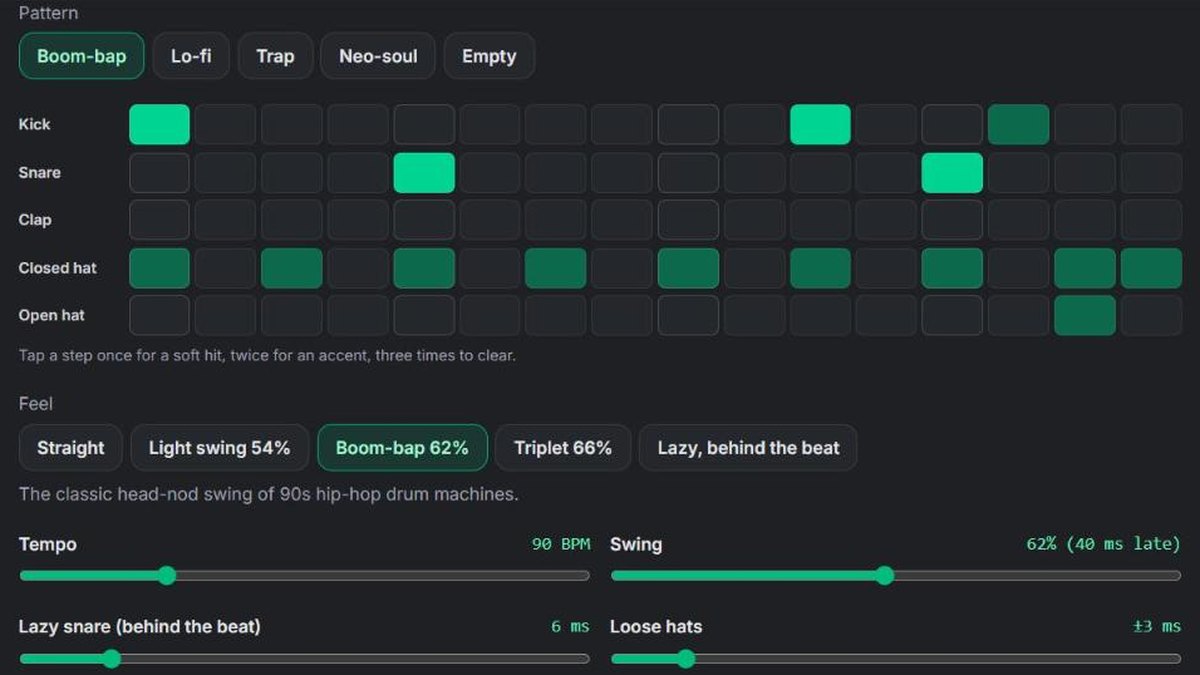
Play two drum loops with exactly the same notes. One sounds like a machine; the other makes your head nod. The difference is almost always swing: a tiny, deliberate delay on some of the notes. It is a few hundredths of a second, and it is the reason a hip-hop beat feels relaxed, a shuffle bounces and a house groove skips.
This guide explains what swing is, what the swing percentage on your drum machine or DAW actually means (with the exact milliseconds), which swing settings different genres use, how swing differs from "humanize", and how to add both to your own drums. You can hear and test every setting in the free Drum Swing & Humanizer, which shows the delay in milliseconds as you move the slider.
What is swing in music? In short
Swing is a rhythm feel in which notes that would be evenly spaced are played long-short instead: the second note of each pair is delayed. On drum machines and in DAWs, swing is set as a percentage. 50% is straight (no swing), about 54% is a light bounce, 58–62% is the classic hip-hop drum-machine swing, and 66% is a full triplet shuffle. At 90 BPM, 62% swing on 16th notes delays every off-beat 16th by 40 milliseconds.
Swing, explained simply
Count "1-and-2-and-3-and-4-and" at a steady pace. If every syllable is the same length, that's straight time. Now say it with a bounce, so the numbers are a little longer and the "ands" a little shorter and later: "1——and 2——and". That long-short feel is swing.
In jazz, swing is played on 8th notes, and it's learned by ear rather than written: sheet music shows even 8ths, and the players swing them. In hip-hop, R&B, house and most modern production, swing is usually applied to 16th notes (the hi-hats), and it's set with a control on the drum machine or in the DAW.
Swing never moves the main beats. The kick on beat 1 and the snare on beats 2 and 4 stay where they are. Only the off-beat notes between them move later. That's why a swung beat still feels tight: the anchor points don't change, only the space between them.
What does swing percentage mean?
Swing percentage describes where the second note of each pair lands between two on-beat notes.
Take two 16th notes that together fill one 8th note. Straight, the second 16th lands exactly halfway: 50% of the way through. With swing, it lands later:
- 50%: exactly halfway. Straight, no swing.
- 54%: a little past halfway. A light, subtle bounce.
- 58%: noticeable swing. Smooth, relaxed groove.
- 62%: strong swing. The head-nod feel of classic hip-hop drum machines.
- 66%: two-thirds of the way. This is a triplet feel (long-short in a 2:1 ratio), a full shuffle.
- 70–75%: heavier than a triplet. Very lopsided, used sparingly as an effect.
The percentage idea was popularized by drum machines and samplers in the 1980s, which let producers dial in swing on a grid. It's now in nearly every DAW: FL Studio's swing knob, Ableton Live's groove pool, Logic Pro's quantize swing and the swing control on hardware grooveboxes.
Swing in milliseconds: the real numbers
A percentage is easy to set but hard to feel. What your ears hear is time: how many milliseconds late the off-beat note plays. That depends on the tempo:
Delay = (swing % − 50) ÷ 50 × the length of one 16th note, where one 16th note lasts 15,000 ÷ BPM milliseconds.
Here is how late every off-beat 16th plays at common tempos:
| Swing | 70 BPM | 80 BPM | 90 BPM | 100 BPM | 120 BPM |
|---|---|---|---|---|---|
| 50% (straight) | 0 ms | 0 ms | 0 ms | 0 ms | 0 ms |
| 54% (light) | 17 ms | 15 ms | 13 ms | 12 ms | 10 ms |
| 58% | 34 ms | 30 ms | 27 ms | 24 ms | 20 ms |
| 62% (hip-hop) | 51 ms | 45 ms | 40 ms | 36 ms | 30 ms |
| 66% (triplet) | 69 ms | 60 ms | 53 ms | 48 ms | 40 ms |
| 75% | 107 ms | 94 ms | 83 ms | 75 ms | 63 ms |
Two things stand out:
- The same percentage is more milliseconds at slower tempos. 62% at 70 BPM is 51 ms late; at 120 BPM it's 30 ms. That's why slow lo-fi and boom-bap can feel so loose: the delays are large.
- Small numbers matter. A difference of 10–15 ms is easy to hear in a groove, even though you'd never notice it as a delay on its own.
The Drum Swing & Humanizer shows this number live next to the swing slider ("62%, 40 ms late" at 90 BPM), so you can connect what you hear to the setting.
What swing does each genre use?
These are starting points, not rules. Every producer sets swing by ear, and the same genre can range widely.
| Genre | Typical swing | Note value | Feel |
|---|---|---|---|
| Boom-bap hip-hop | 56–62% | 16ths | Head-nod, heavy pocket |
| Lo-fi hip-hop | 54–62%, plus a late snare | 16ths | Lazy, relaxed, behind the beat |
| Neo-soul and R&B | 54–60%, loose timing | 16ths | Laid-back, often unquantized |
| Trap | 50–54% | 16ths and 32nds | Mostly straight; swing on hi-hat rolls |
| House and UK garage | 54–58% (garage often more) | 16ths | Skipping, shuffling hats |
| Pop and rock | 50–54% | 8ths or 16ths | Mostly straight with a subtle lift |
| Jazz, blues shuffle | Around 60–66% | 8ths | Triplet-based swing |
| Funk | 50–56% | 16ths | Tight, with a little push |
If you want to hear the differences, open the Drum Swing & Humanizer, start a pattern playing and click through the feel presets: Straight, Light swing 54%, Boom-bap 62%, Triplet 66% and Lazy, behind the beat. Same notes, five different grooves.
Swing on 8th notes vs 16th notes
Swing always works on pairs of notes, so you choose which note value gets swung:
- 16th-note swing moves the second 16th of every pair. It's the norm for hip-hop, R&B, lo-fi and house at 70–130 BPM, where the hi-hats play 16ths.
- 8th-note swing moves the second 8th of every pair. It's the norm for jazz, blues shuffles and very fast tempos, where 16th notes would be too quick to swing audibly.
If a beat at 85 BPM sounds like it's "galloping" rather than nodding, you've probably swung the 8ths when you wanted the 16ths.
Swing vs humanize: what's the difference?
They're often confused, but they do different jobs:
- Swing moves every off-beat note by the same amount. It's consistent, so the groove stays tight and repeatable.
- Humanize adds small random changes to timing and loudness, so no two hits are identical, the way a real drummer never plays the exact same hit twice.
The best-sounding programmed drums usually use both: swing for the groove, plus a touch of humanize so it breathes. On top of that, producers often move individual drums:
- Late snare (behind the beat): pushing the snare and clap 5–25 ms late gives the "lazy" or "drunk" feel heard in a lot of neo-soul and lo-fi. The kick stays on the grid, so the beat still lands.
- Loose hi-hats: small timing changes on the hats only, so the top of the groove floats.
- Velocity variation: varying how hard each hit is played. Often more important than timing for a natural feel.
The Drum Swing & Humanizer has a control for each: Lazy snare, Loose hats, Human timing (up to ±25 ms) and Velocity variation (up to 50%). Press New human take for a different random version with the same settings.
The "drunk", unquantized feel
You've probably heard beats where the drums seem to stumble but still groove perfectly. That feel comes from producers who played or placed drums off the grid on purpose: snares dragging behind the beat, kicks landing a little early, hi-hats at uneven distances. J Dilla's drum programming is the most famous example, and it shaped neo-soul and lo-fi hip-hop.
You can't capture a specific producer's feel with one knob, and the presets in our tool are general styles, not copies of anyone. But you can get into that territory:
- Keep the kick on the grid (or a few milliseconds early).
- Push the snare 15–25 ms late.
- Set swing around 56–60%, then loosen the hats.
- Add a little random timing and plenty of velocity variation.
- Listen for a groove that leans back without falling apart, then stop adjusting.
How to add swing to your drums
In a DAW:
- FL Studio: the swing knob in the channel rack swings step-sequenced patterns; the piano roll's quantize tool can apply swing to notes.
- Ableton Live: apply a swing groove from the groove pool to a MIDI or audio clip, and set its amount.
- Logic Pro: choose a swing quantize value for a region, or use groove templates.
- GarageBand: the quantize menu has swing options for MIDI regions.
In your browser, free:
- Open the Drum Swing & Humanizer.
- Pick a pattern (boom-bap, lo-fi, trap or neo-soul) or program the 16-step grid.
- Press Play and move the Swing slider. Watch the milliseconds change.
- Add a lazy snare, loose hats, human timing and velocity variation.
- Download a 4-bar MIDI file for your DAW, or a WAV or MP3 loop.
Already have a MIDI drum file? Upload it to the same tool and download it swung and humanized: off-beat 16ths move late, General MIDI snares lean back and the hats loosen. The tempo is read from the file, and nothing is uploaded to a server.
The step-by-step version of this is in our how-to on adding swing to drums, and if you're building a whole track, see how to make lo-fi hip-hop beats.
Frequently asked questions about swing
What is swing in music?
Swing is a rhythm feel in which pairs of evenly spaced notes are played long-short: the second note of each pair is delayed. It makes a groove bounce or nod instead of sounding mechanical.
What does 50% swing mean?
50% swing means no swing at all. The second note of each pair lands exactly halfway between the beats, so the rhythm is straight.
What does 66% swing mean?
At 66%, the second note of each pair lands two-thirds of the way through, which is a triplet feel: the first note is twice as long as the second. It's a full shuffle.
What is the best swing for hip-hop?
Most boom-bap and lo-fi hip-hop uses between about 54% and 62% swing on 16th notes. Start at 58–62% and adjust by ear; add a slightly late snare for a lazier feel.
Is swing the same as shuffle?
A shuffle is a strong, triplet-based swing, around 66%. All shuffles are swing, but most swing in modern production is lighter than a full shuffle.
Should I swing the kick drum?
Usually not much. Swing only moves the off-beat notes, and most kicks land on main beats, so they stay put. Keeping the kick on the grid is what keeps a swung beat tight.
How many milliseconds is swing?
It depends on the tempo and percentage. At 90 BPM, 54% swing is about 13 ms late, 62% is 40 ms and 66% is 53 ms. Slower tempos give larger delays for the same percentage.
What's the difference between swing and groove?
Swing is one specific, consistent timing shift. "Groove" is the overall feel of a rhythm, which includes swing plus the timing and loudness of each hit. A groove template in a DAW can contain swing, velocity changes and timing offsets together.
Can I add swing to a MIDI file online?
Yes. The free SongUp AI Drum Swing & Humanizer accepts a .mid file, applies swing and humanize, and gives you the swung MIDI file back. It runs in your browser.
Does swing work at any tempo?
Yes, but the effect changes. At slow tempos swing is very audible and can sound loose; at fast tempos the delays get small, so producers often swing 8th notes instead of 16ths.
The bottom line
Swing is the small delay on off-beat notes that turns a stiff pattern into a groove. Set it as a percentage: 50% is straight, 54% is a light bounce, 58–62% is the classic hip-hop feel and 66% is a triplet shuffle, and remember that the same percentage is more milliseconds at slower tempos. Add humanize on top so no two hits are identical, and keep the kick on the grid. To hear all of it in a few minutes, try the free Drum Swing & Humanizer.