
Every singer eventually asks the same question: why does this song feel easy and that one feel impossible? Most of the time the answer isn't talent. It's range. The song sits too high or too low for your voice. Once you know your vocal range, you can pick songs that suit you, change the key of the ones that don't, and practise in a way that actually stretches your voice instead of straining it.
This guide shows you how to find your vocal range in about ten minutes with a piano (a free online one works), how to read your result, which voice type it points to, and how to use it to choose and transpose songs.
How to find your vocal range, in short
- Warm up for five minutes: humming, lip trills, gentle slides.
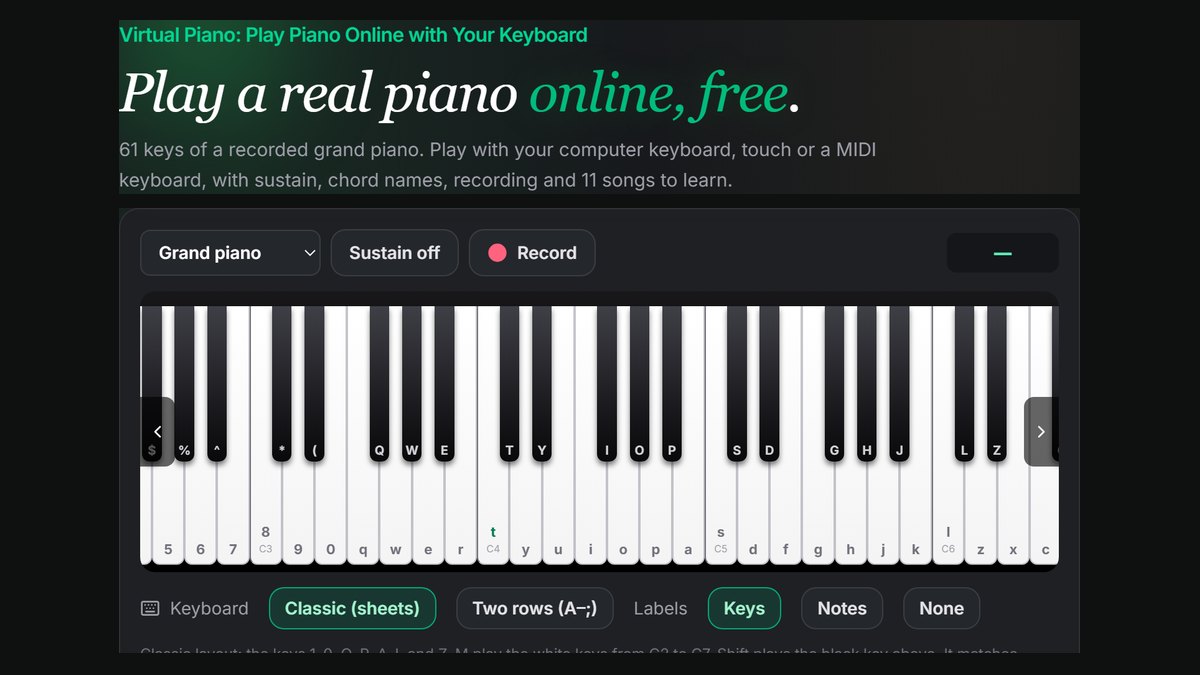
- Open a piano, such as the free Virtual Piano, and find middle C (C4).
- Go down one key at a time, singing "ah" on each note, until you can't produce a clear sound. That's your lowest note.
- Go up from middle C the same way until your voice cracks or strains. That's your highest note.
- Write both notes down, e.g. A2–F4. That's your range.
- Compare it with the voice types table below, and use the comfortable middle of your range to choose song keys.
What is a vocal range?
Your vocal range is the span from the lowest note to the highest note you can sing. It's written with note names and octave numbers, for example C3–G4.
The numbers come from the piano keyboard. Middle C is C4, roughly in the middle of an 88-key piano. The C one octave below it is C3, the C one octave above it is C5, and so on. Between each C are the other notes: C, D, E, F, G, A, B, then the next C.
Two related ideas matter just as much:
- Comfortable range (tessitura): the part of your range where you can sing for a long time, with good tone and no strain. It's usually narrower than your full range, and it's what decides whether a whole song feels good.
- Registers: your voice changes character as it goes up: chest voice (lower, fuller), mixed voice, and head voice or falsetto (lighter, higher). The point where it shifts is called a break or passaggio.
Most untrained adults have a range of about 1.5 to 2 octaves. Trained singers often reach 2.5 to 3 octaves or more. Your range can grow with practice, especially at the top.
What you need
- A piano or keyboard. A real one is great; a free Virtual Piano in your browser works just as well. It shows the note names, so you don't need to know the keyboard.
- A quiet room and about ten minutes.
- Water, and a voice that's warmed up. Testing a cold voice gives you a smaller, less accurate result.
- Optional: a recorder, so you can listen back. The free Voice Recorder records in your browser; turn off "Voice clean-up" when you record singing.
Step 1: Warm up
Spend five minutes warming up before you test. A few simple exercises:
- Humming: hum a comfortable note, then slide up and down gently.
- Lip trills: blow through closed lips so they flutter (like a motorboat) while you slide from low to high.
- Sirens: on "ng" or "oo", slide smoothly from your lowest to your highest note and back, like a siren.
Keep it gentle. Warming up should feel easy, never pushed.
Step 2: Find middle C
On the Virtual Piano, the keys are labelled, so you can find C4 directly. On a real piano, middle C is the white key just left of the pair of black keys nearest the middle of the keyboard.
Play C4 and sing it on "ah". If it feels low, you probably have a higher voice; if it feels high, you probably have a lower one. Either way, it's your starting point.
Step 3: Find your lowest note
From middle C, go down one white key at a time: B3, A3, G3, F3, and so on. Play each note, then sing it on "ah" at a comfortable volume.
Your lowest note is the last one you can sing with a clear, steady sound, even if it's quiet. When the note turns into a croak, a rattle (vocal fry) or just air, you've gone past it. Go back up one note and write that down.
Tips:
- Don't push your chin down to reach low notes. Keep your head level and relaxed.
- Low notes are easier later in the day than first thing in the morning.
Step 4: Find your highest note
Go back to middle C and go up one white key at a time: D4, E4, F4, G4, and so on.
You'll probably notice a point where your voice wants to flip into a lighter sound. That's your break into head voice or falsetto. Note it: it's useful to know. Then keep going in the lighter voice.
Your highest note is the last one you can sing without straining, squeezing or your voice cracking. If it hurts, stop. A note you can only scream doesn't count.
Write down two highs if you like: the highest note in your full chest voice, and the highest note overall, including head voice or falsetto.
Step 5: Write down your range
Put it together, lowest to highest, for example:
- Full range: A2–A4 (with falsetto to D5)
- Break: around D4
- Comfortable range: C3–E4
Repeat the test on another day. Your result can move by a note or two depending on how rested and warmed up you are. Use the range you can reach on an ordinary day, not your best day ever.
What voice type am I?
Classical singing uses six main voice types. Your range is one clue to yours, along with the colour of your voice (darker or brighter) and where your voice feels most comfortable. These are typical ranges for trained singers; untrained voices are often a little narrower.
| Voice type | Typical range | Usually |
|---|---|---|
| Bass | E2 – E4 | The lowest male voice: deep, rich |
| Baritone | A2 – A4 | The most common male voice |
| Tenor | C3 – C5 | The highest common male voice |
| Alto (contralto) | F3 – F5 | The lowest female voice: warm, dark |
| Mezzo-soprano | A3 – A5 | The most common female voice |
| Soprano | C4 – C6 | The highest female voice: bright |
A few things to keep in mind:
- Ranges overlap. A baritone and a tenor can both sing an A3. What differs is where each one sounds best and how easily they get to the top.
- Most people are in the middle. Baritone and mezzo-soprano are the most common voice types. If you're unsure, that's the safest guess.
- Pop singers don't need a label. In contemporary music, what matters is the notes you sing well, not the classical category.
- Your voice isn't defined by gender. Use the type that matches your actual range and comfort.
How to use your range to choose songs
Once you know your comfortable range, you can check any song before you learn it:
- Find the song's lowest and highest melody notes. You can sing along with the piano to find them, or look up the sheet music.
- Compare them with your comfortable range, not your full range. A song that touches your highest note once is fine; a song that lives up there for the whole chorus will tire you out.
- If it's too high or too low, change the key. Moving a song up or down a few semitones (one semitone is one piano key, black or white) often makes it fit perfectly.
Changing the key of a song
You don't have to give up a song that doesn't fit your voice. Change its key:
- For a backing track or a recording: the free Pitch & Key Changer moves a whole song up or down by up to 12 semitones without changing its speed. Lower the key 2–3 semitones and try again.
- For karaoke: remove the vocals with the Karaoke Maker, then shift the key of the instrumental to suit you.
- For playing yourself: move every chord by the same number of semitones, or use a capo on guitar.
A useful rule: if the highest note is 2 semitones too high for you, lower the song by 2 semitones. Then check the lowest note still fits.
How to expand your vocal range
Your range isn't fixed. With regular, careful practice, most people gain a few notes, mostly at the top, and the notes they already have get stronger and easier.
- Warm up every time. Lip trills and sirens across your whole range are the best daily exercise.
- Practise smooth slides through your break, so chest and head voice connect instead of flipping.
- Work on breath support. Breathe low into your belly and ribs, not your shoulders. Steady breath makes high notes easier.
- Go a little at a time. Add one note at the edge of your range, sing it softly, and stop if it strains.
- Rest. Your voice is a muscle. Hoarseness or pain means stop and rest; persistent problems are a reason to see a doctor or a voice specialist.
- Record yourself. Listening back with the Voice Recorder shows you what's really happening, which isn't always what you hear while you sing.
A singing teacher speeds all of this up a lot, especially for finding your break and building a healthy mixed voice.
Frequently asked questions
How do I find my vocal range for free?
Use a free online piano such as the Virtual Piano. Start at middle C (C4), go down one key at a time to find the lowest note you can sing clearly, then go up to find the highest note you can sing without strain. Write both notes down.
What is a good vocal range?
There's no "good" or "bad" range. Most untrained adults sing about 1.5 to 2 octaves; trained singers often reach 3. Tone, control and staying in tune matter far more than the number of notes.
What is the average vocal range?
For untrained adults, around 1.5 to 2 octaves. For men, roughly A2 to A4 is common (baritone); for women, roughly A3 to A5 (mezzo-soprano).
Can I change my voice type?
Your voice type comes mostly from your vocal folds and the shape of your throat and head, so it doesn't change much in adulthood. What you can change is your range within it, your control and how well you connect your registers.
Why does my voice crack on high notes?
Usually it's the switch between chest voice and head voice. Practising slides through your break, singing more softly in that area, and good breath support help the registers blend.
Does falsetto count in my vocal range?
Yes, it's part of your full range. Many singers write two ranges: their full-voice range, and their total range including falsetto or head voice.
How do I find a song's key so I can transpose it?
The free Key & BPM Finder detects the key and tempo of a song file. Once you know the key, you can shift it to fit your voice with the Pitch & Key Changer.
Find your range now
Open the Virtual Piano, warm up for five minutes, and walk down and up from middle C. In ten minutes you'll know which songs suit you, which need a new key, and where to aim your practice. And if you'd like a song written for your range, describe it on SongUp AI and make it your own.