
Sheet music looks like a secret code the first time you see it: five lines, strange symbols, dots with flags and numbers stacked on top of each other. But it's a simple system, and you only need a handful of ideas to start reading real music. Most beginners can read a simple melody within a week of short practice sessions.
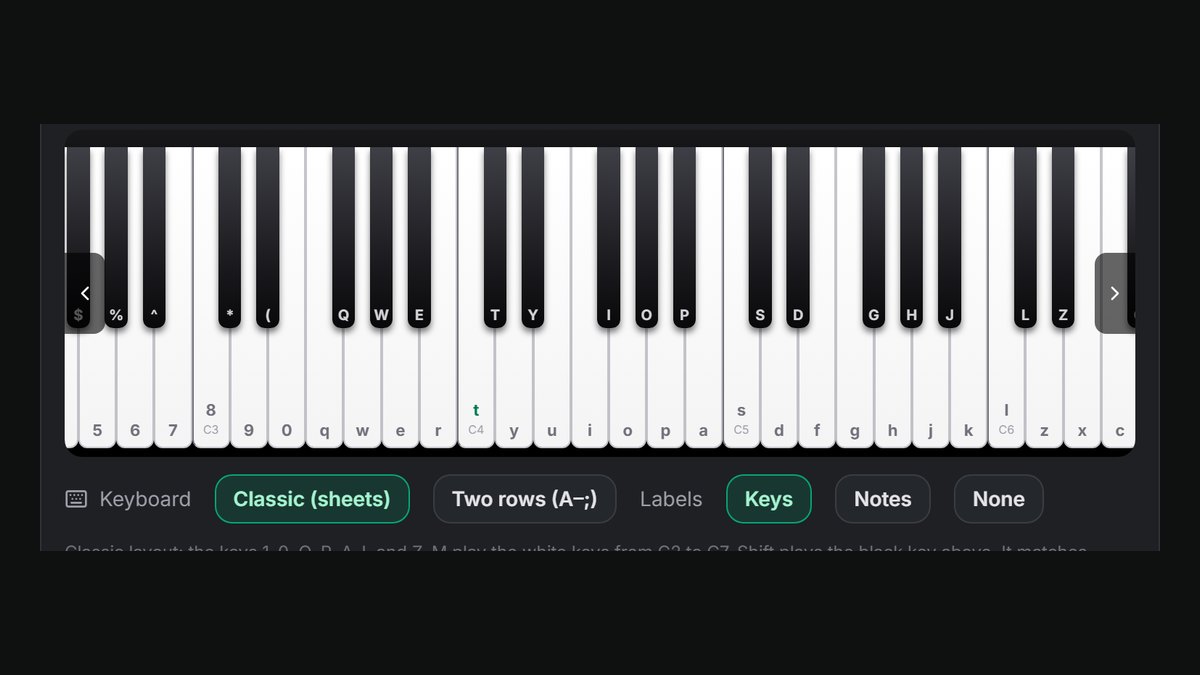
This guide teaches you how to read sheet music from zero: the staff, the treble and bass clefs, note names (with memory tricks), note lengths and rests, time signatures, sharps, flats and key signatures, and the small markings that tell you how to play. Every example can be played straight away on a free Virtual Piano in your browser, so you can hear what you're reading.
How to read sheet music, in short
- The staff is five lines and four spaces. Each line and space is one note.
- The clef tells you which notes they are. Treble clef lines are E G B D F ("Every Good Boy Does Fine"), spaces are F A C E. Bass clef lines are G B D F A ("Good Boys Do Fine Always"), spaces are A C E G ("All Cows Eat Grass").
- The note's shape shows its length: whole (4 beats), half (2), quarter (1), eighth (½).
- The time signature (like 4/4) tells you how many beats are in each bar.
- Sharps (♯) raise a note by one key, flats (♭) lower it, naturals (♮) cancel them.
- Read slowly, count out loud, and play each note on a Virtual Piano to check yourself.
The staff: five lines, four spaces
Music is written on a staff (also called a stave): five horizontal lines with four spaces between them.
- Each line and each space stands for one note.
- Higher on the staff = higher in pitch. A note on the top line sounds higher than a note on the bottom line.
- Lines and spaces are counted from the bottom up: the bottom line is line 1, the top line is line 5.
Notes that are too high or too low for the staff get short extra lines of their own, called ledger lines, above or below it.
The staff is divided into bars (also called measures) by vertical bar lines. A double bar line marks the end of a section; a thick double line marks the end of the piece.
The clefs: which notes are which
On its own, a staff doesn't tell you which notes the lines are. The clef at the start of each line of music does. The two you'll see most:
Treble clef (G clef)
The treble clef (𝄞) is used for higher notes: the right hand on piano, the melody line, violin, flute, guitar and most singers. Its curl wraps around the second line from the bottom, which is the note G. That's why it's also called the G clef.
Treble clef notes:
- Lines (bottom to top): E – G – B – D – F. Memory trick: Every Good Boy Does Fine.
- Spaces (bottom to top): F – A – C – E. Memory trick: they spell FACE.
Bass clef (F clef)
The bass clef (𝄢) is used for lower notes: the left hand on piano, bass guitar, cello, trombone and low voices. Its two dots sit around the second line from the top, which is the note F.
Bass clef notes:
- Lines (bottom to top): G – B – D – F – A. Memory trick: Good Boys Do Fine Always.
- Spaces (bottom to top): A – C – E – G. Memory trick: All Cows Eat Grass.
Middle C: where the two clefs meet
Piano music uses both clefs at once, joined by a brace: this is called the grand staff. Middle C sits exactly between them, on a ledger line just below the treble staff, or just above the bass staff. It's the same note, the C nearest the middle of the piano, called C4.
Find it on the Virtual Piano and play it. Then play the notes going up (D, E, F, G) and down (B, A, G, F). That's the bridge between the two clefs.
The musical alphabet
Music only uses seven letters: A B C D E F G. After G, it starts again at A, one octave higher.
On a piano, the white keys play these seven notes over and over. The black keys come in groups of two and three; C is always the white key just left of a group of two black keys. Once you can find C, you can find every other note by counting up the alphabet.
Note lengths: how long to hold each note
The position of a note on the staff tells you which note. Its shape tells you how long to hold it, counted in beats.
| Note | What it looks like | Beats (in 4/4) |
|---|---|---|
| Whole note | Hollow oval, no stem | 4 |
| Half note | Hollow oval with a stem | 2 |
| Quarter note | Filled oval with a stem | 1 |
| Eighth note | Filled oval, stem and one flag | ½ |
| Sixteenth note | Filled oval, stem and two flags | ¼ |
Eighth and sixteenth notes next to each other are often joined by a thick beam instead of separate flags. It means the same thing and is easier to read.
Two more symbols change the length:
- Dot: a dot after a note adds half its value. A dotted half note is 2 + 1 = 3 beats. A dotted quarter note is 1 + ½ = 1½ beats.
- Tie: a curved line joining two notes of the same pitch means play the first and hold it for the length of both.
(A curved line over notes of different pitches is a slur: play them smoothly, connected.)
Rests: counting the silence
Silence is written with rests, and every note length has a matching rest:
- Whole rest: a small block hanging below the fourth line. 4 beats (or a whole empty bar).
- Half rest: a small block sitting on the middle line. 2 beats. (Memory trick: the half rest sits like a hat; the whole rest hangs like a hole.)
- Quarter rest: a squiggly vertical line. 1 beat.
- Eighth rest: like a small 7 with a dot. ½ beat.
Count rests exactly as carefully as notes. Most rhythm mistakes are rests that were rushed.
Time signatures: counting the beat
At the start of the music, after the clef, you'll see two numbers stacked like a fraction. That's the time signature.
- The top number tells you how many beats are in each bar.
- The bottom number tells you which note gets one beat: 4 means a quarter note, 8 means an eighth note.
Common time signatures:
| Time signature | Means | Feel | Heard in |
|---|---|---|---|
| 4/4 (also written C) | 4 quarter-note beats per bar | Steady, "1-2-3-4" | Most pop, rock, hip-hop |
| 3/4 | 3 quarter-note beats per bar | Waltz, "1-2-3" | Waltzes, many folk songs |
| 2/4 | 2 quarter-note beats per bar | March, "1-2" | Marches, polkas |
| 6/8 | 6 eighth notes, felt as 2 groups of 3 | Rolling, "1-2-3-4-5-6" | Ballads, jigs, some love songs |
Count out loud while you read: "1, 2, 3, 4" for every bar of 4/4, saying "and" for eighth notes in between ("1 and 2 and…"). A Metronome keeps your count steady; start slowly, around 60 BPM.
Sharps, flats and naturals
Between most white keys on a piano there's a black key. Sharps and flats are how sheet music reaches them.
- Sharp (♯): play the note one key higher (one semitone). F♯ is the black key just right of F.
- Flat (♭): play the note one key lower. B♭ is the black key just left of B.
- Natural (♮): cancels a sharp or flat; play the plain white key.
A sharp, flat or natural written right before a note is called an accidental. It lasts until the end of that bar, for that note, and then it's cancelled automatically by the bar line.
Note that F♯ and G♭ are the same key on the piano. Which name is used depends on the key of the music.
Key signatures: the sharps and flats for the whole piece
Instead of writing the same sharp on every F, music puts the sharps or flats at the start of every line, right after the clef. This is the key signature, and it applies to every note with that name, in every octave, for the whole piece (unless it changes).
- No sharps or flats: C major (or A minor). All white keys.
- One sharp (F♯): G major (or E minor). Every F is played as F♯.
- One flat (B♭): F major (or D minor). Every B is played as B♭.
Two quick tricks for naming the key:
- Sharps: the key is one note above the last sharp. Last sharp is F♯ → key of G major.
- Flats: the key is the second-to-last flat. Flats B♭ and E♭ → key of B♭ major. (One flat is the exception: F major.)
Not sure what key a song is in? The free Key & BPM Finder detects it from the audio.
Dynamics, tempo and other markings
Sheet music also tells you how to play. These words and symbols are usually in Italian:
Dynamics (volume):
- pp pianissimo (very soft), p piano (soft), mp mezzo-piano (moderately soft)
- mf mezzo-forte (moderately loud), f forte (loud), ff fortissimo (very loud)
- Crescendo (a widening "<" shape, or cresc.): get gradually louder
- Decrescendo / diminuendo (">" shape, or dim.): get gradually softer
Tempo (speed):
- Largo / Adagio: slow
- Andante: walking pace
- Moderato: moderate
- Allegro: fast and lively
- Presto: very fast
Many modern scores simply write a number, like ♩ = 120, meaning 120 quarter-note beats per minute.
Articulation and repeats:
- Staccato (a dot above or below the note): short and detached
- Accent (>): play that note stronger
- Fermata (𝄐, an eye shape): hold the note longer than written
- Repeat signs (a double bar with two dots): go back and play the section again
How to practise reading sheet music
Reading music is a skill like reading words: it gets faster with a little practice every day. A routine that works:
- Learn the notes of one clef first. Use the memory tricks, then name every note in a simple piece before you play it.
- Clap the rhythm of each line before you play it, counting out loud.
- Play slowly, with a Metronome at 60 BPM, and only speed up once it's correct.
- Check by ear. Play each note on the Virtual Piano; if it doesn't sound like the tune you know, check the note name again.
- Read something new every day, even for five minutes. Simple songs you already know are perfect, because your ear tells you when you're wrong.
- Don't write the letter names under every note for long. It helps on day one, then becomes a crutch.
For simple tunes to start with, see our 11 easy piano songs for beginners. The Virtual Piano's Play along mode lights up the next key and waits for you, which is a good bridge between letter notes and real notation.
Frequently asked questions
How long does it take to learn to read sheet music?
Most beginners can read simple melodies in a week or two with 10–15 minutes a day. Reading fluently, at speed and in both clefs, takes months of regular practice.
What's the easiest way to remember the notes?
Use the memory tricks: treble clef lines Every Good Boy Does Fine, spaces FACE; bass clef lines Good Boys Do Fine Always, spaces All Cows Eat Grass. Then practise naming notes until you don't need them.
Do I need to read sheet music to play an instrument?
No. Many great musicians play by ear or read chord charts and tabs. But reading music makes it much faster to learn new pieces and to play with others.
Is sheet music the same for every instrument?
The system is the same. Instruments use the clef that fits their range: piano uses treble and bass, violin and flute use treble, cello and bass use bass, and viola uses the alto clef. Guitar music is written in treble clef, an octave higher than it sounds.
What's the difference between a tie and a slur?
A tie joins two notes of the same pitch: play once and hold for both. A slur joins different notes: play them smoothly, without a break.
What does 4/4 mean in music?
It's a time signature: 4 beats in every bar, and a quarter note gets one beat. It's the most common time signature in popular music.
Can I practise reading music without a piano?
Yes. A free Virtual Piano in your browser plays a recorded grand piano with your computer keyboard, a touchscreen or a MIDI keyboard, and it names the notes and chords as you play.
Start reading
Open the Virtual Piano, find middle C, and play the treble clef lines E G B D F and spaces F A C E. Then take one simple song and read it slowly, bar by bar, counting out loud. In a week, those five lines will stop looking like a code, and start sounding like music.