To write a song for someone who passed away, start with small, true memories rather than big words about loss: the name you called them, one place you picture them, one thing they always said. Then decide who the song speaks to, build a short chorus around one line you most want to say to them, and let two verses carry the details.
You don't need to play an instrument or read music. This guide walks through it step by step, with a memory worksheet, a song shape that works for a funeral or an anniversary, a table of clichés and what to write instead, original lyric starters you can borrow, and a complete short example song. At the end are three ways to hear your words sung, how to play the song at a service, and how to look after yourself while you write.
In short
- Start with memories, not rhymes: ten minutes of notes about ordinary things (a sound, a phrase, an object) gives you more song than an hour of staring at a blank page.
- Pick one point of view: a song sung to them, about them, or in their voice from them. Mixing all three is the most common reason a memorial song feels muddled.
- Build the chorus around one line: their name plus the single thing you most want to say, repeated so people can hold on to it.
- Specific beats pretty: "your coffee cup still hangs on its hook" says more than "gone but not forgotten".
- You can hear it sung without singing: sing it yourself, ask a musician, or paste your lyrics into an AI song maker such as SongUp AI.
Before you start: what is the song for?
The same memories can become very different songs depending on where they will be heard. Decide this first, because it sets the length, the mood and how private the details can be.
| Where the song will be heard | Who is listening | What works | What to leave out |
|---|
| Funeral or memorial service | Family, friends, colleagues, people who knew them a little | A clear chorus with their name, details most of the room will recognize, about 3 minutes | Private jokes only two people understand, anything about how they died |
| Celebration of life | People who want to smile as well as cry | A warmer tempo, a funny habit or two, a chorus people can sing back | Very slow, very dark arrangements |
| Anniversary of the death, a birthday after they've gone | Close family | A song that looks at the year since: what changed, what didn't | Long explanations; everyone already knows the story |
| Headstone setting, scattering of ashes | A small group outdoors | Short, simple, easy to play from a phone speaker | Long bridges and quiet intros nobody will hear |
| A private keepsake | Just you, or you and one other person | Anything true, including anger, guilt and the things you never said | Nothing. This is the one song with no rules |
If you are not sure yet, write the private version first. It is easier to soften a true song for a room than to make a polite song feel true. You can keep the private version for yourself and make a second, gentler draft for the service.
If you are choosing the rest of the music for the service too, our guide to funeral songs covers the most-played songs, hymns and how many pieces fit in a typical service. This guide is only about writing your own.
How do you start writing a song about losing someone?
Most people sit down to write a memorial song and try to write the feeling: grief, love, missing them. The feeling is real, but it is also the same for everyone. What makes a song about your person is the detail only you remember. So the first step is not writing lyrics. It is making notes.
The 10-minute memory worksheet
Set a timer for ten minutes. Answer each prompt below with something you could see, hear, smell or touch. Don't edit, don't rhyme, and don't worry if an answer seems too small. Small is what you want.
| Prompt | Example answer (for a fictional grandmother) |
|---|
| What did you call them? | Nana Jo, never Josephine |
| Where do you picture them? | At the kitchen window with the radio on |
| A sound that was theirs | Humming hymns off-key while she dried the dishes |
| Something they always said | "Wear a coat, it's colder than it looks" |
| An object that still feels like them | Her blue cardigan on the back of the chair |
| A smell that brings them back | Lemon, butter and the cold air when she opened the back door |
| What they taught you | How to fold a pie crust with your thumb |
| A day you keep going back to | The snow day she let us skip school and make pies |
| Something that annoyed you about them | She always said she was "fine" when she wasn't |
| What you never got to say | That I learned to be brave from watching her |
| Where you find them now | In my daughter's laugh, in every lemon pie |
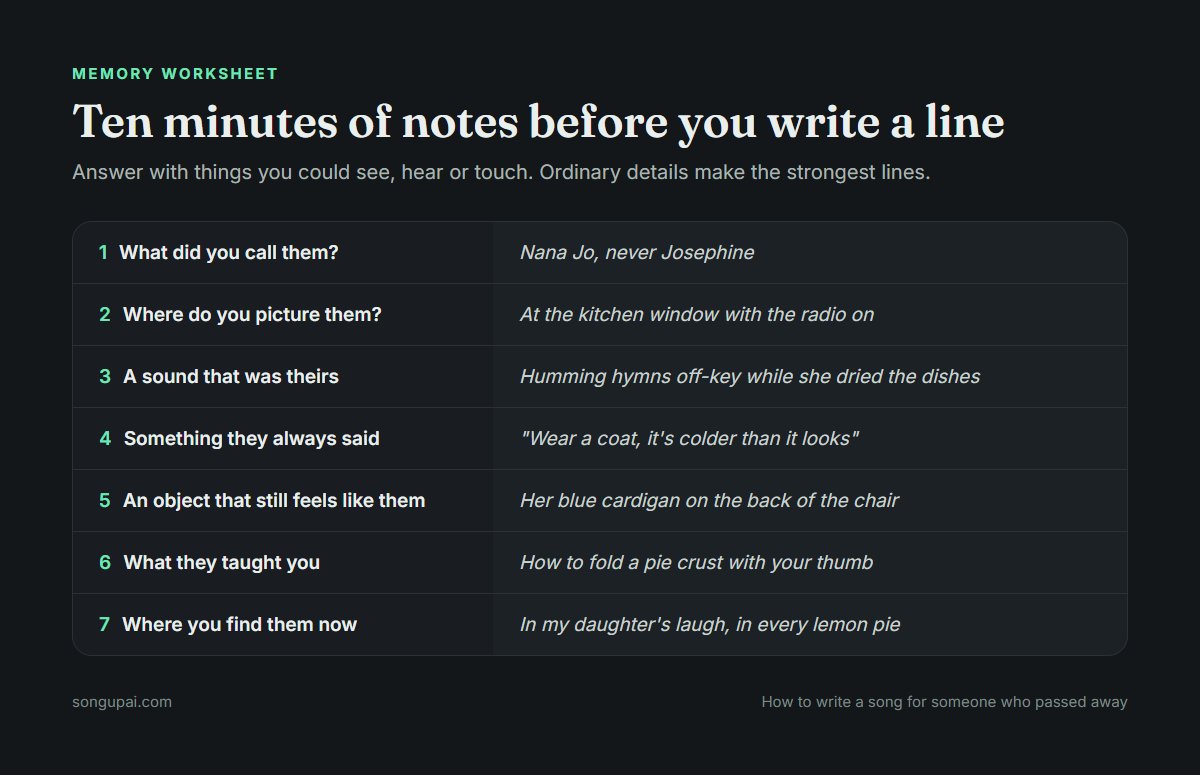
When the timer ends, read your answers and underline the three that made you feel something. Those three are your song. The rest you can save for a eulogy, a card or a second verse.
Ask the family
If the song is for a service, ask two or three relatives the same prompts. A sibling will remember a different kitchen, a different saying, a different song on the radio. You don't have to use everything. But a line the whole family recognizes is the line that makes a room go quiet.
Write down their words exactly
If they had a phrase, write it exactly as they said it, including the grammar and the accent. "Wear a coat, it's colder than it looks" is stronger than "she always cared about us". Their own words, sung back, are often the line people remember most.
Who is the song speaking to? Choosing the point of view
Before you write a single lyric, decide who is talking and who is listening. There are three choices, and each one makes a different song.
| Point of view | How it sounds | Best for | Watch out for |
|---|
| To them ("you") | "You left your cardigan on the chair" | Private songs, anniversaries, the first year | Can feel too intimate for a large service; check that you're comfortable sharing it |
| About them ("she", "he", "they") | "She hummed the hymns off-key" | Funerals and celebrations of life, where you are telling the room who they were | Can feel distant; add one line that speaks to them directly, often in the last chorus |
| From them ("I", in their voice) | "Don't cry too long, put the kettle on" | Comfort for family, especially children | Only if you knew them well enough to speak for them; family members may feel differently |
Most memorial songs written for a service work best "about them" in the verses and "to them" in the chorus. That way the room learns who they were, and then hears you speak to them. Whatever you choose, keep it steady inside each section. Switching from "you" to "she" in the middle of a verse confuses listeners who are already emotional.
What should a memorial song be about? A simple song structure
You don't need a complicated structure. Almost every song people sing along to uses the same shape: verses that change, and a chorus that stays the same. For a memorial song, each part has a job.
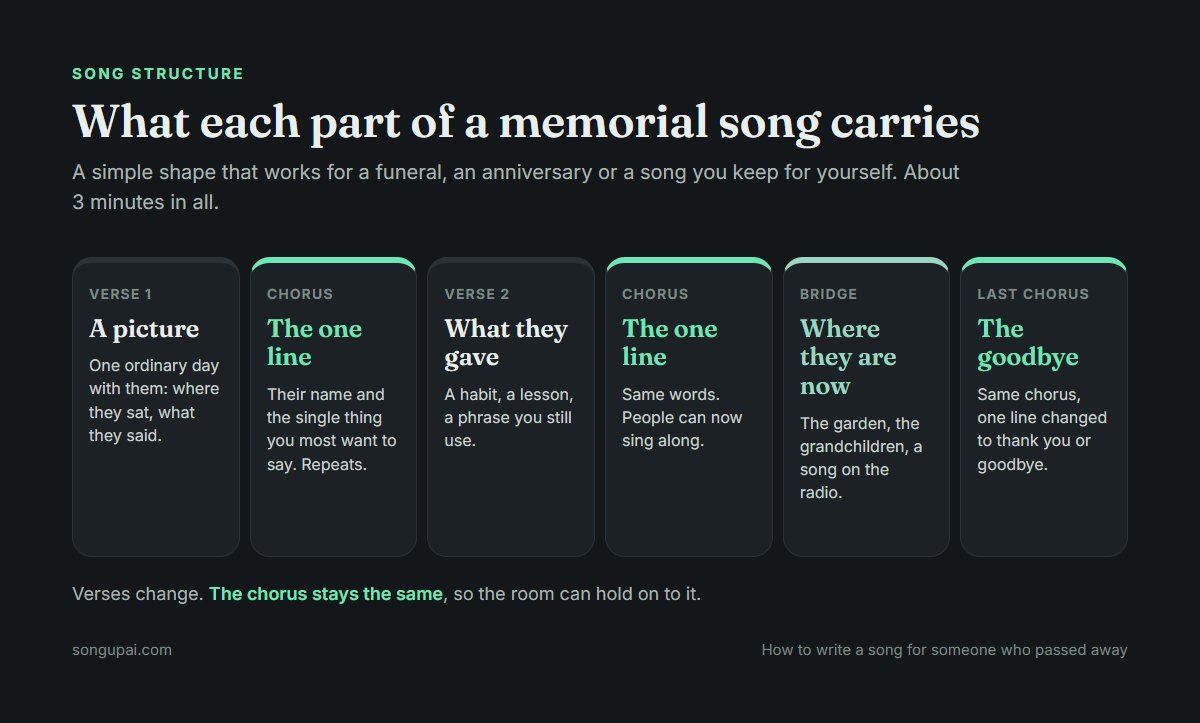
| Part | Length | What it carries | Example (Nana Jo) |
|---|
| Verse 1 | 4 lines | A picture: one ordinary day, where they were, what they were doing | Kitchen window, radio on, humming hymns |
| Chorus | 2–4 lines | The one line: their name and what you most want to say | "Wear a coat, it's colder than it looks" |
| Verse 2 | 4 lines | What they gave you: a habit, a lesson, a phrase | Folding the pie crust with your thumb |
| Chorus | Same words | Repetition, so the room can join in or simply hold on | Same as before |
| Bridge (optional) | 2–4 lines | Where you find them now | Your daughter's laugh, a lemon pie |
| Last chorus | Same, one line changed | The goodbye, or a thank-you | "I'm wearing my coat, Nana" |
This shape runs about three minutes when sung, which fits most services. If the funeral director gives you less time, drop the bridge. If you want something longer for a private keepsake, add a third verse.
For more on song structure in general, our step-by-step guide on how to write a song explains verses, choruses and bridges for any kind of song.
How to write the chorus around one line
The chorus is the part people remember, and the part they'll hum on the drive home. Write it before the verses.
1. Find the one line. Look at the three answers you underlined on your worksheet. Ask: if I could say one sentence to them, or about them, what would it be? It might be their saying ("Wear a coat, it's colder than it looks"), a thank-you ("You taught me how to stay"), or an image ("Your light's still on in the kitchen").
2. Put their name next to it. The name doesn't have to be in every line, but it should be in the chorus. Use the name the family called them: Nana, Pops, Uncle Ray, Mom. If the name is long, sing the short form.
3. Repeat, don't explain. A chorus is not the place for new information. Two lines that come back three times are stronger than four lines full of facts. Simple, repeated words are what a grieving room can actually sing.
4. Say it out loud. Read your chorus aloud three times. If you stumble on a word, change it. If it sounds like a greeting card, make it more specific.
The chorus test
Could this chorus be about anyone else?
If the answer is yes, swap one word for a detail from your worksheet: their name, their saying, their place. One specific word is often enough to make a general line belong to one person.
Using their name and specific details in the verses
Verses are where the details live. A good memorial verse is a small scene, like a photograph in words.
Show one moment, not a whole life. You can't fit 80 years into four lines. Pick one ordinary moment: Sunday morning, the drive to school, the porch at night. Ordinary moments are what people miss most, and everyone in the room will have their own version of them.
Use concrete nouns. Cardigan, kettle, toolbox, porch light, the blue truck. Nouns you can see carry more feeling than adjectives like "kind", "beautiful" or "special".
Use one sense per line. "The radio was on" (sound). "Lemon on your hands" (smell). "The cold step by the door" (touch). This keeps lines short and makes them feel real.
Let a little humor in. If they were funny, the song can be too. A line about how they cheated at cards, or burned the toast every Saturday, gives people permission to smile, and that is often what a family needs.
Leave out the end. Most memorial songs don't mention the illness, the accident or the hospital. If you need to write about the hard parts, a private version is the place for it.
We go further into choosing details for any song about a person in what to write in a personalized song, including a fill-in song brief.
How to rhyme without clichés
Songs about loss attract the same phrases again and again: better place, angel above, forever in my heart. They are kind phrases, and people mean them. But in a song they slide past the ear, because the listener has heard them a thousand times.
The fix is simple. Keep the feeling, and swap the phrase for a detail.
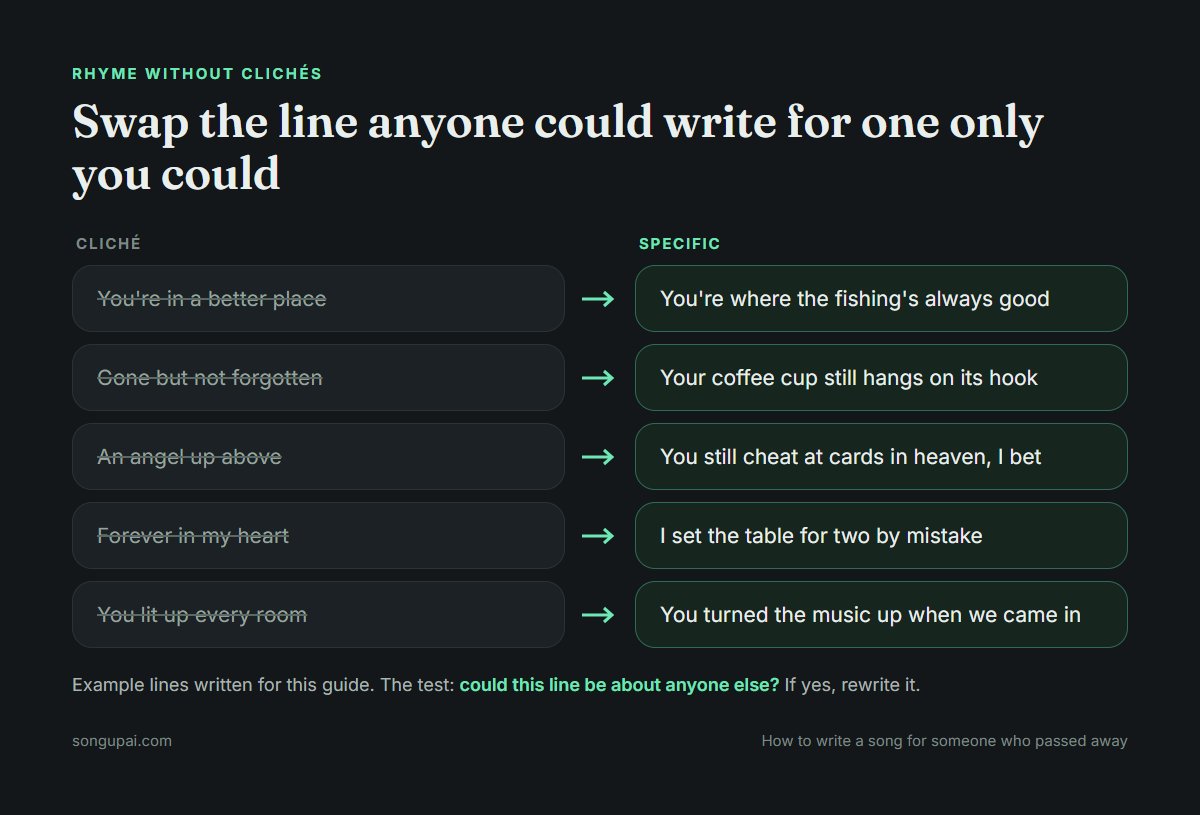
| Cliché | What it is trying to say | A specific line instead (written for this guide) |
|---|
| You're in a better place | I hope you're at peace | You're where the fishing's always good |
| Gone but not forgotten | I still think of you every day | Your coffee cup still hangs on its hook |
| An angel up above | You were good, and I believe you're watched over | You still cheat at cards in heaven, I bet |
| Forever in my heart | I can't stop loving you | I set the table for two by mistake |
| You lit up every room | People were happy around you | You turned the music up when we came in |
| Rest in peace | Your suffering is over | No more early shifts, no more cold hands |
| I'll never forget you | You changed me | I still fold my shirts the way you showed me |
| See you on the other side | I hope we meet again | Save me a seat by the window, like you always did |
Rhyme tips that keep the meaning first
- Use near rhymes. "Home" and "alone", "door" and "more", "light" and "night" are fine, but so are "kitchen" and "missing", "coat" and "close". Near rhymes sound natural and give you far more choices.
- Rhyme only lines 2 and 4. In a four-line verse, only the second and fourth lines need to rhyme. That halves the work and keeps your best detail in place.
- Never change the memory to fit the rhyme. If she drove a Ford, don't make it a Chevy because it rhymes. Change the line around it instead.
- Use a rhyme list, then choose. Our free Rhyme Finder for Songwriters lists perfect and near rhymes for a word, so you can pick one that is true.
If a rhyme makes the line less true, drop the rhyme. Many of the most moving songs don't rhyme perfectly. Listeners forgive a loose rhyme. They notice a false detail.
Lyric starters for someone who passed away
Below are original starter lines written for this guide. Use them to get unstuck: change the details to your own, keep the shape. These are our own words, not lyrics from any existing song, so you are free to use them.
For a parent
- You left the porch light on for me, I leave it on for you
- I hear you in my own voice when I tell my kids to call
- Your toolbox in the garage still knows the shape of your hands
For a grandparent
- Sunday smelled like your kitchen, and it still does in my head
- You taught me cards and cheating, and I'm grateful for them both
- The garden gate still sticks the way it did when you were here
For a partner
- Two cups on the counter, I only fill the one
- I still sleep on my side of the bed, in case you're coming home
For a friend
- We said we'd drive that coast road when we finally had the time
- The group chat's gone so quiet since your name stopped lighting up
For the anniversary of a death
- A year of firsts without you, and I made it through them all
- The calendar says a year, my heart still says last night
Endings and goodbyes
- I'm not saying goodbye, I'm saying see you at the door
- Thank you is too small a word, so I wrote you this instead
A complete example: a short song for a grandmother
Here is a short memorial song built from the worksheet answers above, for a fictional grandmother, Nana Jo. It uses the "about her" point of view in the verses and speaks to her in the chorus. It's written for this guide and free to adapt.
"Colder Than It Looks"
[Verse 1]
Radio on by the kitchen window,
Hymns she only half knew,
Blue cardigan on the back of the chair,
Lemon on her hands, flour on her shoes.
[Chorus]
Wear a coat, Nana Jo, I hear you say,
It's colder than it looks out there today.
I'm buttoned up and walking in the snow,
You're still the warmest thing I know.
[Verse 2]
She showed me how to fold the crust,
Press it with your thumb and turn,
Said "I'm fine" when she was tired,
Gave away the last slice every time it burned.
[Chorus]
Wear a coat, Nana Jo, I hear you say,
It's colder than it looks out there today.
I'm buttoned up and walking in the snow,
You're still the warmest thing I know.
Notice what the song does and doesn't do. It never says "grief", "loss" or "heaven". It names her, shows two ordinary scenes, and builds the chorus on the one thing she always said. A bridge could add where the family finds her now ("my daughter laughs the way you did"), and the last chorus could change one line to "I wore my coat today, Nana Jo".
What kind of music fits a memorial song?
The music matters as much as the words. The right style is usually the one they loved, not the one you think a funeral needs.
| Their taste, or the feeling you want | Style to ask for | Tempo | Instruments |
|---|
| Quiet, reflective, a traditional service | Gentle piano ballad | Slow (about 60–75 beats per minute) | Piano, soft strings |
| Faith was central to their life | Hymn-style or gospel | Slow to medium | Organ, choir, piano |
| They loved country music | Country ballad | Slow to medium | Acoustic guitar, fiddle, pedal steel |
| A celebration of life | Warm folk or soft pop | Medium (about 90–110 beats per minute) | Acoustic guitar, light drums, hand claps |
| A younger person, a friend | Indie folk or acoustic pop | Medium | Guitar, soft synth, light percussion |
| An older generation | 1940s–1960s ballad or crooner style | Slow | Piano, brushed drums, upright bass |
| A family from another country | Their traditional style, in their first language | Any | Traditional instruments of that culture |
A few practical points:
- Slow doesn't have to mean sad. A slow song in a major key with warm instruments can feel like comfort rather than despair.
- Match the tempo to your words. Long lines need a slower song. Short, punchy lines suit a medium tempo. If you want to check a song's speed, the free Tap Tempo tool counts beats per minute as you tap along to a recording you like.
- If you play a little guitar or piano, three or four chords are enough. Our guide on how to write a chord progression shows simple progressions that suit a gentle song.
- Language counts. If your grandmother prayed in Spanish or your father sang in Tagalog, a chorus in their first language can mean more to the family than any English line.
How can I hear my memorial song sung?
Once the words are written, you have three ways to hear them as a song. None is better than the others. It depends on time, budget and whether you want a live moment.

1. Sing it yourself
You don't need a trained voice. Speak your lyrics slowly over a simple tune you hum, record it on your phone, and listen back. If you play an instrument, add three or four chords. A shaky, real voice at a small family gathering can be the most moving version of all. For a big service, though, many people find they can't get through it on the day, so record it beforehand.
2. Ask a musician
A musical friend, the church organist, a local singer or a music teacher can set your words to a tune and perform them. Ask early: services are often arranged within a week or two, and musicians need time to learn new words. Give them your lyrics with the sections labeled and a recording of a song in the style you want. Fees vary, so ask directly.
3. Paste your lyrics into an AI song maker
If you can't sing and don't have a musician to ask, you can paste your words into SongUp AI. Label each section with [Verse], [Chorus] and [Bridge], describe the music (for example, "gentle piano ballad, soft strings, warm female vocal, peaceful, not dark"), choose the language, and the AI sings your lyrics as written, with a full arrangement.
How it works today (checked 2026-11-12):
- Open Lyrics to Song or the memorial song page, and sign in with a free account. No card is needed to start.
- Paste your lyrics with the section labels, and describe the style, the voice and the mood.
- Hear a free 30-second preview of your own lyrics sung, before you pay anything.
- Get the full song. On the memorial song page, one song is $2.99, paid once, with no subscription. Prices can differ by country and plan, so see pricing for yours.
- Listen alone first. If a line doesn't sit right, change the words and make it again.
- Download the MP3 for the service.
If you'd rather not write every word yourself, you can also describe the person (their name, two or three details and the style you want) and let the AI write the lyrics. The worksheet answers above make a good description.
Hear your words as a memorial song
How to share or play the song at a service
A song you wrote deserves to be heard well. A few steps save stress on the day.
- Tell the funeral director or celebrant early. Ask how they play music (a CD, a USB stick, a phone or a streaming link) and send the file a few days before. Bring a copy on a USB stick and on your phone as a backup.
- Test it on their speakers. A song that sounds gentle in headphones can be too quiet in a large room. Ask for a sound check if you can.
- Introduce it. One sentence helps the room listen: "Nana always told us to wear a coat. I wrote this for her." Keep the introduction short.
- Print the words. Put the chorus in the order of service so people can follow, or sing along the second time.
- Ask first in a place of worship. Some churches allow only hymns or sacred music during the service itself. A hymn-style song may be accepted; if not, play it at the reception or the graveside.
- For a live singer, make an instrumental backing track. On SongUp AI you can ask for "instrumental, no vocals", or run a finished song through the Karaoke Maker, which removes the vocals and comes with paid plans.
- For family who can't travel, send the song as a file or a private link with a short message and a photo.
- For a slideshow, a three-minute song fits about 30 photos at 6 seconds each.
If you plan to sing it yourself
Record a backup, even if you mean to sing live.
Grief can close your throat without warning. Give the backup recording to someone you trust and agree on a signal. If you can't go on, they press play, and the song still gets heard.
Taking care of yourself while you write
Writing about someone you've lost brings the feelings close. That is part of why it helps, and part of why it can be hard. A few things make it gentler.
Write in short sessions. Twenty minutes is enough. Stop when you feel overwhelmed and come back another day. The song will wait.
Let the first draft be messy. It doesn't have to rhyme, scan or make sense yet. The first draft is for you. The second is for the room.
Write with someone. A sibling or a friend can answer worksheet prompts with you, and often remembers the detail you'd forgotten. Shared writing can turn into a few hours of telling stories, which is worth having even if the song never gets finished.
Expect tears, and expect laughter. Both are normal. You may also feel guilty for enjoying the writing. That is normal too.
There is no deadline for a private song. A song for a funeral has a date. A song for yourself can take a year. Some people write a verse on each anniversary.
Ask for support if you need it. The NHS has a clear page on grief after bereavement or loss, including when to get help (checked 2026-11-12). In the UK, Cruse Bereavement Support runs a free helpline on 0808 808 1677, and Samaritans answer on 116 123 in the UK and Ireland. In the US, call or text 988 for the 988 Suicide & Crisis Lifeline; in Canada, call or text 9-8-8. In Australia, Lifeline answers on 13 11 14. All numbers checked 2026-11-12.
Paste your lyrics: hear 30 seconds free
Writing for a grandmother who is still with you? A song for Grandma works as a birthday or Christmas present, and many families say they're glad they made one while she could hear it.
How to write a song for someone who passed away: FAQ
How do you write a song for someone who passed away?
Start with ten minutes of notes about small, specific memories: what you called them, where you picture them, something they always said. Choose one point of view (to them, about them, or from them). Write a short chorus around one line with their name, then two verses that each show one ordinary scene. Read it aloud and replace any line that could be about anyone else.
How do you start a memorial song?
Start with a picture, not a feeling. The first line of the first verse should put the listener somewhere real: the kitchen, the porch, the truck, the pew. "Radio on by the kitchen window" draws people in faster than "I miss you so much".
What do you write in a song about losing someone?
Write about the person, not only the loss: their name, their sayings, their habits, the things they gave you, and where you still find them now. Keep the details concrete and ordinary. Leave out the illness or how they died unless the song is private.
How long should a memorial song be?
About three minutes, which is two verses, a chorus sung three times, and an optional short bridge. That fits most funeral services. A private keepsake can be any length.
Can I write a funeral song if I can't sing or play an instrument?
Yes. Write the lyrics, then ask a musician to set them to music, or paste them into an AI song maker that sings your words, such as SongUp AI's memorial song page. You can hear a free 30-second preview of your own lyrics before paying.
Should a memorial song rhyme?
It helps listeners follow along, but it isn't required. Rhyme only the second and fourth lines of each verse, use near rhymes like "kitchen" and "missing", and never change a true detail just to make a rhyme.
Can I use lines from a famous song in my memorial song?
Not in your own lyrics, especially if you plan to record or share the song. Song lyrics are protected by copyright. Write your own lines, and play the original song separately in the service if it meant something to them.
What is a good song to write for a grandparent who died?
Build it around their home and their habits: their kitchen or workshop, a saying they repeated, something they taught you with their hands, and the grandchildren who carry them on. The example song "Colder Than It Looks" above shows that shape for a grandmother.

