
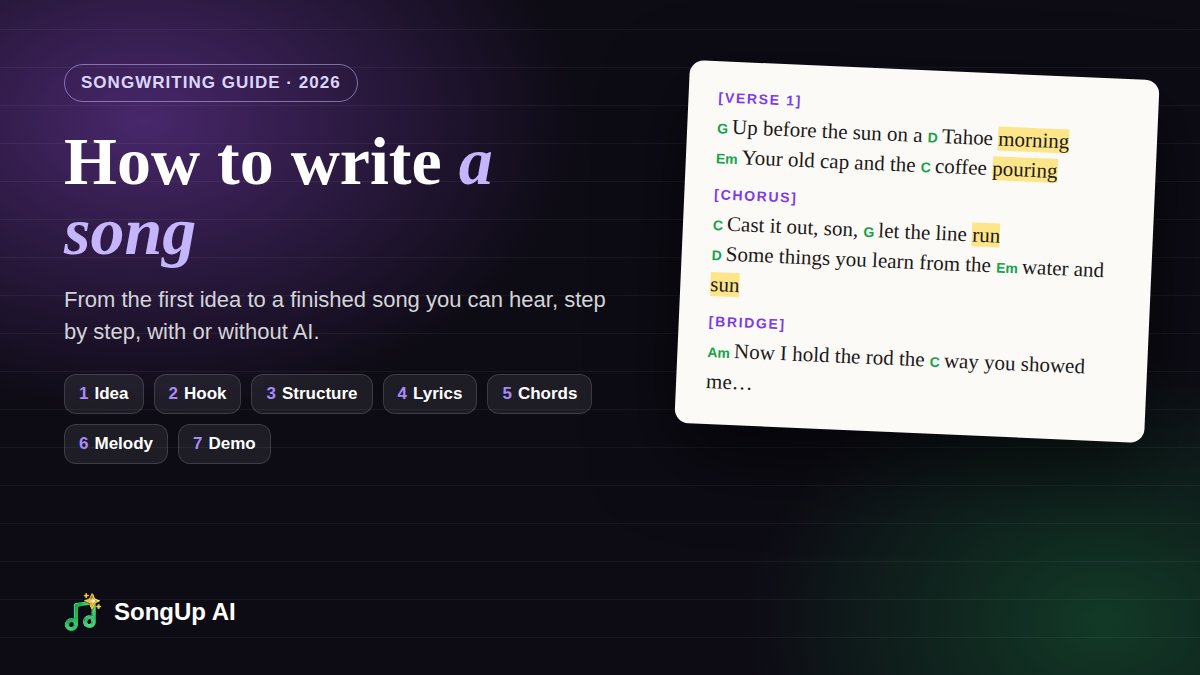
You don't need to play an instrument, read music or have studied songwriting to write a good song. You need an idea worth singing about, a simple shape to pour it into, and a way to hear it so you can make it better. This guide covers all three, step by step, the way working songwriters do it.
We'll write one song together as we go, a country song about a dad teaching his kid to fish at Lake Tahoe, so you can see each step in action. At the end you'll have a finished lyric, chords and a melody, and you'll know how to turn it into a recording you can share, release or give as a gift.
We build SongUp AI, so where AI can save you time we show you how. You can follow every step with nothing but a notebook.
How to write a song, in short
- Start with one specific feeling or moment, not a big topic.
- Write the hook first: the short line people will sing back. It usually becomes the title.
- Choose a structure. Verse, chorus, verse, chorus, bridge, chorus works for almost any song.
- Write the chorus lyrics around the hook, then verses that tell the story with details.
- Pick a chord progression. Four chords are enough for a hit.
- Find a melody by singing the lyrics over the chords, or by humming first.
- Make a demo so you can hear it, then rewrite the weakest line.
Step 1: Find a song idea worth writing
Most first songs fail because the idea is too big. "Love", "life" and "summer" aren't song ideas; they're subjects. A song idea is one person, one moment and one feeling.
| Too big | A real song idea |
|---|---|
| A song about my dad | The morning my dad taught me to fish, and the day I took my own kid |
| A love song | Dancing in the kitchen at 2 a.m. because the power went out |
| A song about moving | Handing back the keys to the first apartment we couldn't afford |
| A birthday song | My grandma turning 90 and still beating everyone at cards |
Where to find ideas:
- Your phone's camera roll. Every photo is a moment with a place, people and a feeling.
- Things people say. Write down phrases that catch your ear. "Some things you learn from the water" came from a conversation, not a brainstorm.
- Titles first. Many professional writers keep a list of titles and write the song later. A strong title is half the song.
- Someone you love. Personal songs for a birthday, an anniversary or a wedding are the easiest to write because you already know the details. Our birthday song and love song pages have prompts to spark ideas.
Our example: the idea is "my dad teaching me to fish at Lake Tahoe, and realizing years later that he was teaching me more than fishing." It has a person, a place, a moment and a feeling.
Step 2: Write the hook and the title
The hook is the part people remember: usually a short line in the chorus that repeats. In most songs, the hook is also the title. Writing it first gives every other line something to point at.
A good hook is:
- Short. Three to seven words. "Shake It Off", "Let It Be", "Old Town Road".
- Singable. Open vowels (ah, oh, ay) are easier to hold on a long note than closed ones.
- Repeatable. It should make sense the first time and mean more the third time.
- Specific to your song. "I love you" is a line; "Kitchen floor at 2 a.m." is a hook.
Try writing 10 hook ideas in five minutes, then circle the one you'd most want to sing out loud.
Our example: "Some things you learn from the water" became the hook and the title.
Step 3: Pick a song structure
Song structure is the order of the sections. You don't have to invent one. The verse-chorus form below is the shape behind most pop, country, rock and R&B songs.
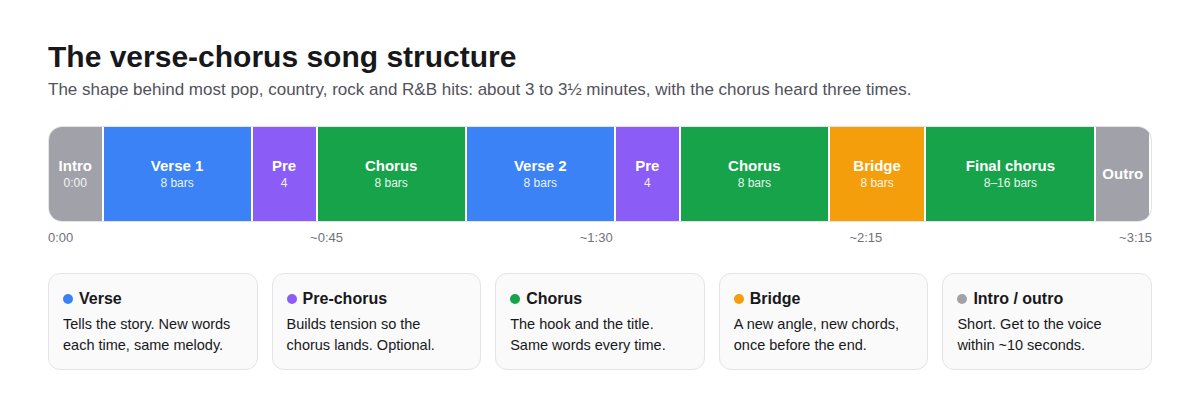
What each section does:
- Verse: tells the story. Each verse has new words but the same melody. Two verses are usually enough.
- Pre-chorus (optional): two to four lines that build tension and make the chorus feel like a release.
- Chorus: the emotional center. It holds the hook and repeats with the same words each time.
- Bridge: a new angle, near the end, often with different chords. It's where the song turns: a realization, a flashback, a question.
- Intro and outro: keep them short. Listeners decide in seconds whether to keep listening, so get to the voice quickly.
Other common structures:
| Structure | Pattern | Good for |
|---|---|---|
| Verse-chorus | V C V C B C | Almost everything |
| Verse-chorus without bridge | V C V C C | Short, simple songs, kids' songs |
| AABA | Verse, verse, bridge, verse | Standards, jazz, older ballads |
| Verse-refrain | Verses that end on the same line | Folk, storytelling, hymns |
| Hip hop | Intro, 16-bar verse, hook, 16-bar verse, hook | Rap. See the AI rap generator |
If you're writing your first song, use verse-chorus. Label your page [Verse 1], [Chorus], [Verse 2], [Bridge] before you write a word. Those same labels are what AI song generators read, so your lyric sheet doubles as a prompt later.
Step 4: Write the chorus lyrics
Write the chorus before the verses. It's the part that repeats, so it carries the most weight, and once you know where the song lands, the verses are easier to aim.
A chorus usually has four lines with the hook in the first or last line (or both). It should be the most general part of the song: the feeling everyone can relate to. Save the specific details for the verses.
Our example chorus:
[Chorus]
Cast it out, son, let the line run
Don't you rush what takes its time
Some things you learn from the water
And some things you learn from the sun
The hook is in line three, and lines one and four rhyme (run / sun). The chorus states the lesson; it doesn't explain it. The verses will.
Step 5: Write the verses with details
Verses are where most songs win or lose. The rule every songwriting teacher repeats is show, don't tell: instead of saying how you felt, describe what you saw, heard, smelled and touched, and let the listener feel it.
- Tell: "I was happy when my dad took me fishing."
- Show: "Up before the sun on a Tahoe morning / Your old cap and the coffee pouring."
A useful exercise is object writing: set a timer for 10 minutes and write everything you can remember about one object or place from the song, using all five senses. Then pick the best four images for the verse.
Rules of thumb for verses:
- Verse 1 sets the scene: who, where, when.
- Verse 2 moves time forward. Same melody, new information. A second verse that repeats the first is the most common beginner mistake.
- Each line should be worth singing. If a line only exists to rhyme, cut it.
Our example verses:
[Verse 1]
Up before the sun on a Tahoe morning
Your old cap and the coffee pouring
You tied my hook with your hands so steady
Said "Hold it soft, and wait till it's ready"

[Verse 2]
Now the cap's on my head and it's a little worn
My little girl's asleep in the car since dawn
I tie her hook the way you showed me
And I hear you laughing when the line goes free
Verse 2 jumps a generation, so when the chorus comes back, "Cast it out, son" means something new.
Step 6: Rhyme, rhythm and syllables
Rhymes make lyrics feel finished and easy to remember, but forced rhymes are worse than none.
Rhyme schemes describe which lines rhyme. Common ones for a four-line section:
| Scheme | Pattern | Effect |
|---|---|---|
| AABB | 1 and 2 rhyme, 3 and 4 rhyme | Punchy, simple, great for choruses |
| ABAB | 1 and 3 rhyme, 2 and 4 rhyme | Smooth and flowing, common in verses |
| XAXA | Only 2 and 4 rhyme | Natural and conversational, common in hit songs |
| ABBA | 1 and 4 rhyme, 2 and 3 rhyme | Feels resolved, good for a closing section |
Use near rhymes (slant rhymes). "Morning / pouring", "time / mind", "home / alone" all work in songs even though they aren't perfect rhymes. They sound more natural than "fire / desire" and give you far more options.
Count syllables. Lines that will be sung to the same melody should have about the same number of syllables, so verse 2 fits the melody of verse 1. Clap the rhythm of each line; if one stumbles, trim a word.
Keep lines short. Under about 10 syllables per line is easy to sing, for you and for an AI singer.
Prosody is the match between the words and the music: happy words over bright chords, a question that rises in the melody, a long note on the most important word. If something feels "off" about a line, prosody is usually why.
Step 7: Write the bridge
The bridge comes once, usually after the second chorus. It's the song's turning point: a new perspective, a confession, a flashback or a realization. Musically it often uses chords the rest of the song hasn't, so it feels like stepping into a different room.
Our example bridge:
[Bridge]
Now I hold the rod the way you showed me
And the lake's still the same, it's just us who got older
You never said much about living
But you said it all on that shore
After the bridge, the final chorus hits harder, because the listener now knows the hook was never really about fishing.
Step 8: Choose chords (even if you don't play)
You don't need to know music theory to choose chords. A small number of progressions power thousands of songs; pick one, loop it, and write over it.
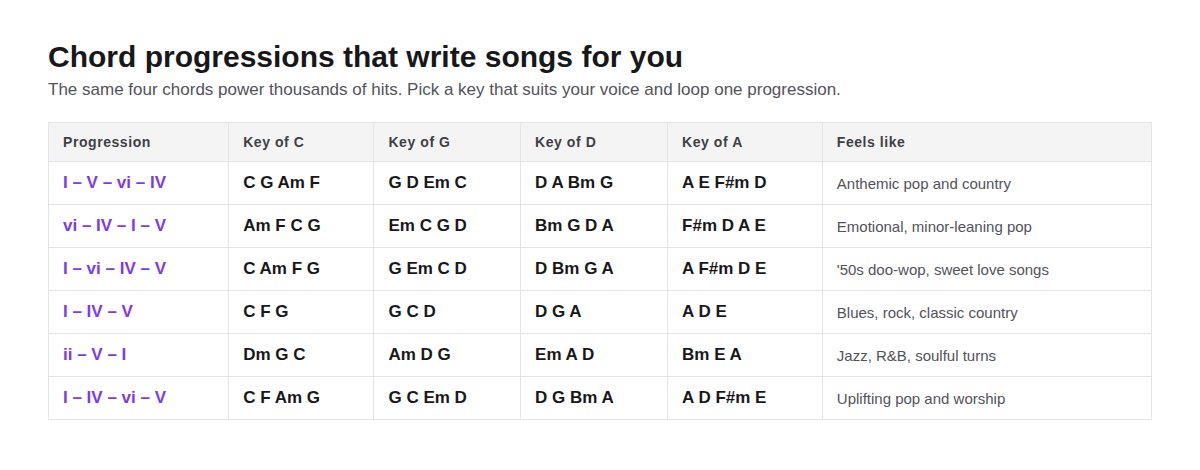
How to use the table:
- Pick a key that fits your voice. If the chorus feels too high or too low to sing, move everything to another column.
- Use one progression for the verse and a different one for the chorus, or the same chords starting in a different place (I–V–vi–IV in the verse, vi–IV–I–V in the chorus).
- Give the bridge a chord you haven't used yet, like the iii (Em in C) or the ii (Dm in C).
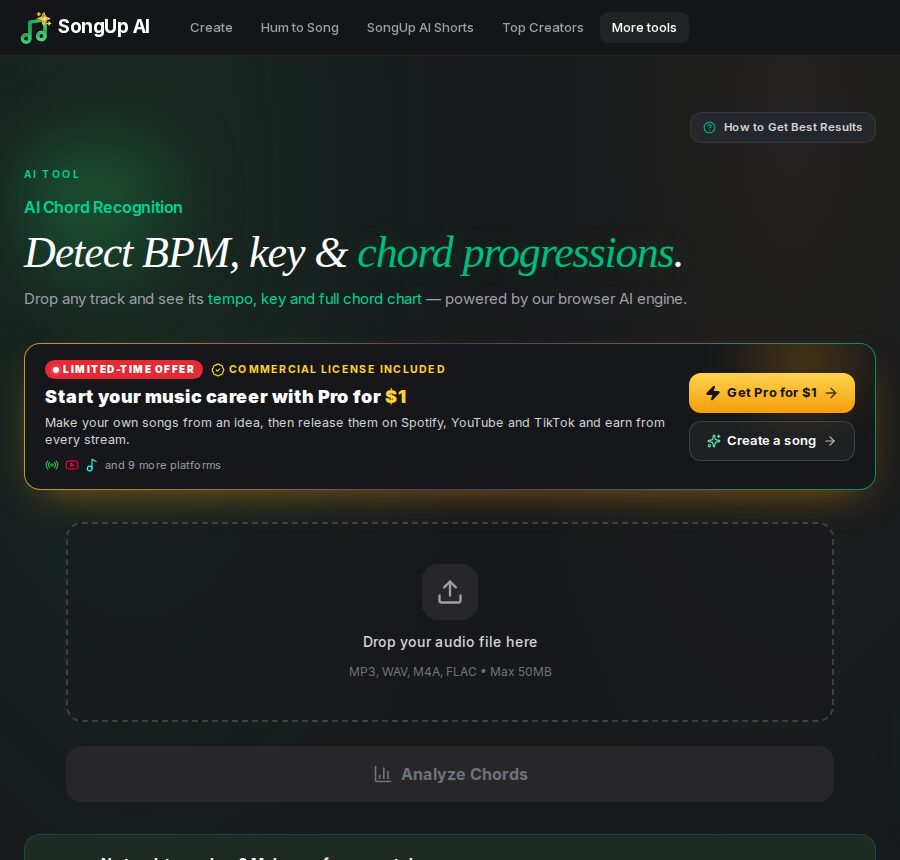
Learn from songs you love. Upload a song to our free Chord Finder and it shows the key, the tempo and every chord change on a timeline. It's the quickest way to see that most of your favorite songs use the progressions above.
Our example: key of G, verses on G–D–Em–C, chorus on C–G–D–Em, bridge starting on Am.
Step 9: Write a melody
The melody is the tune the words are sung to. If you've never written one, these three methods work for beginners:
- Speak, then sing. Read a lyric line out loud with feeling. Notice where your voice naturally rises and falls, then exaggerate it into a tune. Your melody will already fit the words.
- Sing over the chords. Loop your chord progression (a free online piano like our Neural Synth works) and improvise "la la la" until something sticks. Record everything on your phone.
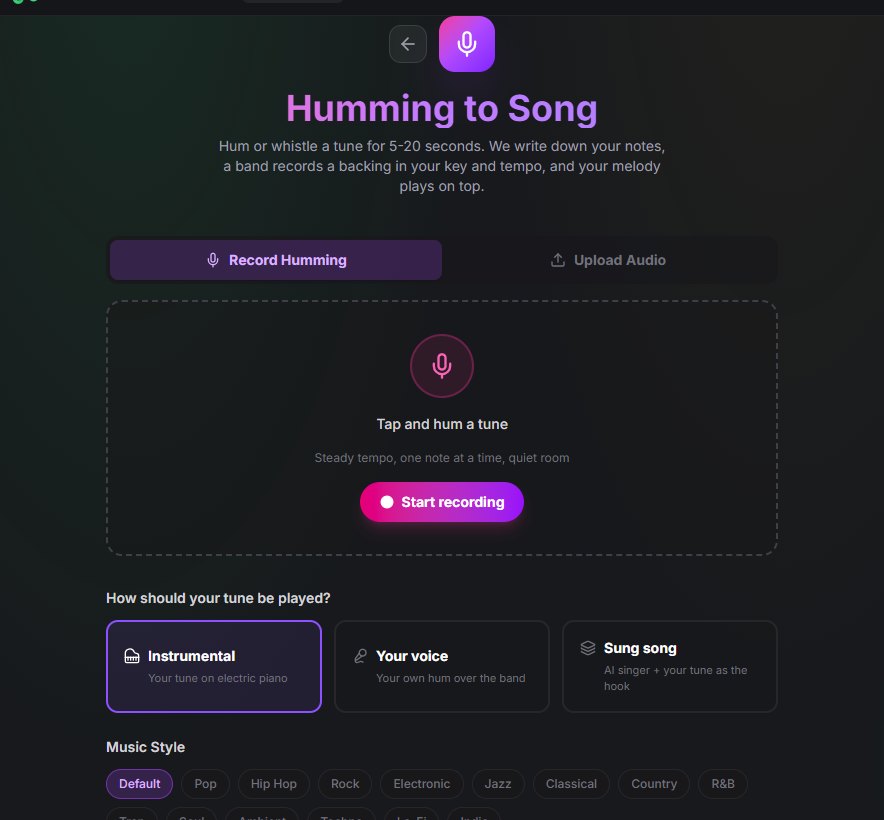
- Hum first, write words later. Many hit melodies started as a hum in the car. Record it, then fit the lyrics to it.
Melody tips that make a chorus memorable:
- Put the chorus higher than the verse. Lifting the melody a few notes makes the chorus feel like a payoff.
- Change the rhythm between sections. If the verse is busy, make the chorus use longer notes, and vice versa.
- Repeat the hook melody exactly every time it appears. Repetition is what makes it stick.
- Land long notes on open vowels and important words.
If you want to see the notes of a hummed melody, Audio to MIDI turns a recording into notes you can open in any music app. Our guide on how to turn humming into a song covers recording a hum the AI can read.
Step 10: Make a demo so you can hear it
A song on paper isn't finished until you hear it. Demos show you which lines are hard to sing, where the song drags and whether the chorus really lifts. You have three options:
| Option | What you need | Best for |
|---|---|---|
| Phone voice memo | Your voice, maybe a guitar or piano | Checking melody and lyrics fast |
| Home recording | A mic, a DAW (GarageBand is free on Apple devices) | Musicians who want to produce it themselves |
| AI song generator | Your lyrics and a style description | Hearing a full band and a trained singer in minutes, without playing anything |
To hear your lyrics as a full song with SongUp AI:
- Open Create and describe the sound: "heartfelt modern country, acoustic guitar, pedal steel and brushed drums, warm male vocal, 80 BPM".
- Under Customize & Advanced, choose Write Lyrics and paste your lyrics with the
[Verse],[Chorus]and[Bridge]labels. - Press Create Song. A minute or two later you hear your words sung over a full arrangement.
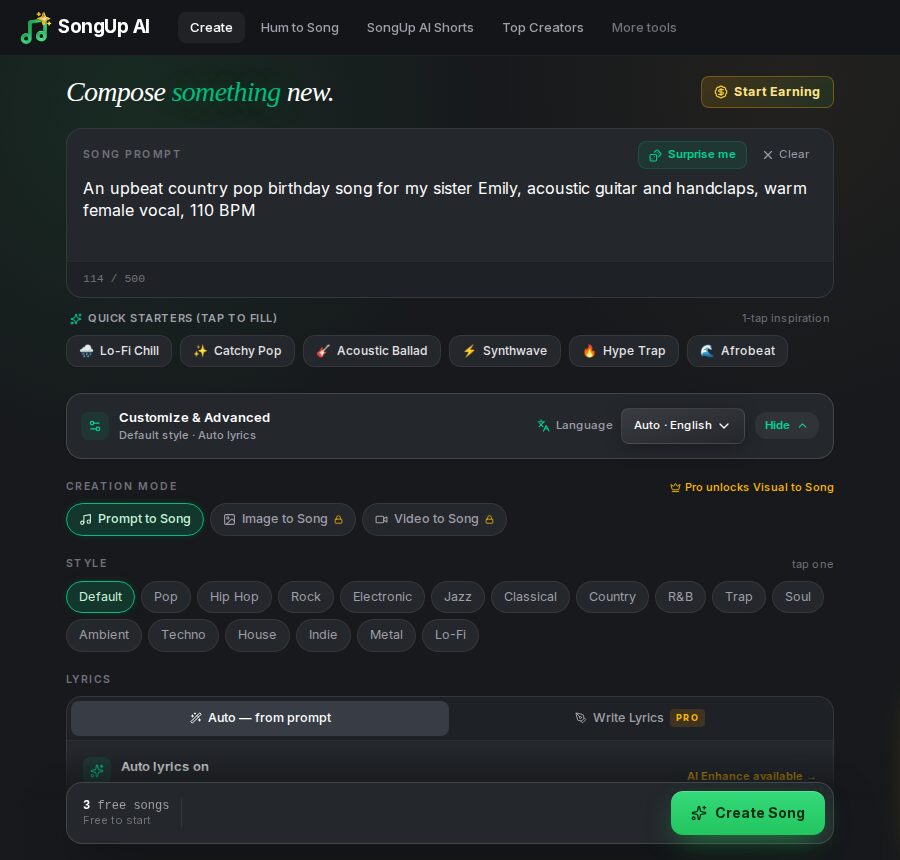
Singing your own lyrics is part of Pro, which is currently $1 for the first month with 5 songs, or you can get one song for $2.99 with no subscription. A free account can hear one free 30-second preview of its own words first. Details are on the pricing page and the lyrics to song page.
Then listen like an editor: which line did you skip past? Rewrite it and make the song again. Changing one line at a time is how professionals finish songs.
Writing lyrics with AI: when it helps and when it doesn't
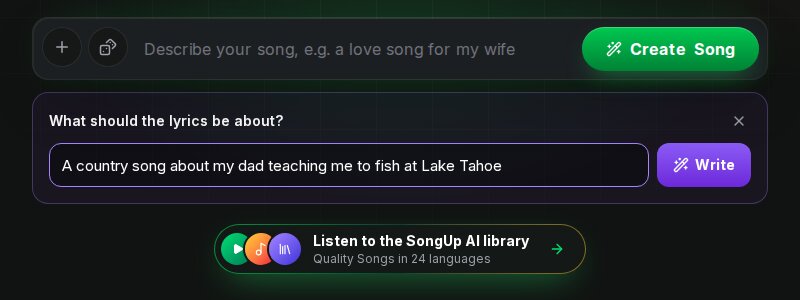
AI is a useful writing partner when you're stuck, as long as you stay the songwriter. On SongUp AI, Write lyrics with AI is free: tell it what the song is about, including names and a memory, and it drafts lyrics with verses, a chorus and a bridge. Free accounts can write 5 sets of lyrics a day.
Good uses of AI lyrics:
- Breaking writer's block with a first draft you then rewrite
- Finding rhymes and alternative words for one stubborn line
- Trying the same idea in different styles (country vs. pop vs. rap)
- Personal songs, where your details (names, places, inside jokes) make the lyric yours
Where you should lead:
- The idea, the title and the specific details. AI defaults to general images; your memories are what make a song land.
- The final edit. Read every line out loud and cut anything you wouldn't say.
- Copyright. In the US, the Copyright Office protects human authorship, so lyrics you write or substantially rewrite are more clearly your own work. Our AI music copyright guide explains the rules.
For the full AI workflow, from prompt to finished song, read How to Make a Song with AI and the 40 AI song prompts guide.
How to write different kinds of songs
The ten steps work for any song, but each genre has its own habits.
How to write a love song
Skip the clichés (heart, fire, forever) and write about one real moment between two people. The best love songs feel like overhearing a private conversation. Put their name or a nickname in the chorus if it's a gift. Our AI love song generator has anniversary and wedding prompts.
How to write a rap song
Rap is built on rhythm first: write 16-bar verses over a beat, keep the hook simple, and use internal rhymes (rhymes inside the line, not only at the end) and multi-syllable rhymes. Make a beat to write over with the AI beat maker, or hear your bars performed with the AI rap generator.
How to write a song for someone (birthday, wedding, Mother's Day)
List ten details only you would know: how they laugh, a place, a saying, a habit. Use three in the verses and their name in the chorus. Keep it short (two verses and a chorus is plenty), because the moment you play it matters more than the length. If you're short on time, a custom song gift is $2.99 and comes with a gift page that plays the song with your message and photo. For birthdays, see the birthday song generator; for the holidays, the Christmas song generator.
How to write a song on guitar or piano
Play the progression from the table above in a comfortable key, strum or play it slowly, and sing the hook over it until the melody settles. Change the strumming pattern or the rhythm of the left hand between the verse and the chorus to give each section its own feel.
How to write a song without playing an instrument
Write the lyrics, hum the melody into your phone, and use tools to fill in the rest: Hum to Song plays your hummed melody over a band, and an AI song generator can sing your lyrics over a full arrangement. Some professional topliners (writers who write only melody and lyrics) don't play an instrument at all.
How to write a song with no lyrics (instrumentals)
Instrumentals still need a hook: a riff or a short melody that repeats. Build sections the same way (A section, B section, return to A) and change the energy with drums and texture rather than words. For background music, see the AI lo-fi music generator or the background music generator.
Our finished example song
Here's the full lyric we wrote in this guide, ready to paste into any songwriting app or AI song generator:
[Verse 1]
Up before the sun on a Tahoe morning
Your old cap and the coffee pouring
You tied my hook with your hands so steady
Said "Hold it soft, and wait till it's ready"

[Chorus]
Cast it out, son, let the line run
Don't you rush what takes its time
Some things you learn from the water
And some things you learn from the sun

[Verse 2]
Now the cap's on my head and it's a little worn
My little girl's asleep in the car since dawn
I tie her hook the way you showed me
And I hear you laughing when the line goes free

[Chorus]
Cast it out, girl, let the line run
Don't you rush what takes its time
Some things you learn from the water
And some things you learn from the sun

[Bridge]
Now I hold the rod the way you showed me
And the lake's still the same, it's just us who got older
You never said much about living
But you said it all on that shore

[Final Chorus]
Cast it out, son, let the line run
Don't you rush what takes its time
Some things you learn from the water
And some things you learn from the sun
Notice the small change in the second chorus ("son" becomes "girl"). Changing one word in a repeated chorus is a classic trick that makes the listener hear it fresh.
After the song: protect it, release it, share it
- Copyright: in the US your song is protected by copyright as soon as it's written down or recorded. Registering it with the US Copyright Office (copyright.gov) gives you stronger legal protection if someone copies it.
- Get paid as a songwriter: register your songs with a performing rights organization such as BMI or ASCAP for performance royalties, and with The MLC for streaming mechanical royalties.
- Release it: distributors such as DistroKid, TuneCore and CD Baby put your recording on Spotify, Apple Music and YouTube Music. Our guide to making money with AI music walks through it, and Start earning explains what SongUp AI songs can be released.
- Share it as a gift: turn a recording into a gift page, a lyric video or a printable lyric sheet with the song extras.
- Polish it: fix the pitch of a sung demo with AI Auto-Tune, sing over an instrumental from the karaoke maker, and finish with AI mastering. The AI music producer guide covers the whole production process.
Songwriting mistakes beginners make
- Starting with a subject instead of a moment. Narrow it until you can picture it.
- A chorus with no hook. If you can't point to the line people will sing back, you don't have one yet.
- Verse 2 repeats verse 1. Move the story forward in time or perspective.
- Forced rhymes. Use near rhymes, or rewrite the line so a natural word lands at the end.
- Too many words. If a line is hard to sing at normal speed, cut it in half.
- Long intros. Get to the voice fast.
- Never finishing. A finished song with flaws teaches you more than a perfect unfinished one. Give yourself a deadline and make a demo.
Frequently asked questions about writing a song
How do I start writing a song for the first time?
Pick one specific moment and write the hook first: a short line that sums up the feeling. Then write a four-line chorus around it and two verses that tell the story. Use verse-chorus structure and a four-chord progression. If you get stuck, Write lyrics with AI gives you a free first draft to rewrite.
What comes first, lyrics or melody?
Either works. Writers who think in words start with a title and lyrics; writers who think in sound start with a hum or a chord loop. If you hum ideas often, try Hum to Song to hear your melody with a band, then write lyrics to fit.
How long should a song be?
Most popular songs are between 2½ and 3½ minutes: two verses, three choruses and a bridge. Songs for a birthday or a social media clip can be shorter. Paid SongUp AI songs can also be extended or remixed later.
How many lines should a verse and chorus have?
A common shape is four to eight lines per verse and four lines per chorus. Keep both verses the same length so they share a melody. Our AI song prompts guide has examples of full lyric layouts.
How do I write a catchy chorus?
Make the hook short and repeat it, sing the chorus higher than the verse, use longer notes than the verse, and keep the words general enough that anyone can sing along. Test it by humming it an hour later; if you remember it, it works.
Can I write a song if I can't sing or play an instrument?
Yes. Write the lyrics, hum or describe the melody, and let tools perform it. An AI song generator sings your lyrics over a full arrangement, and lyrics to song explains how to format them so the AI follows your structure.
Is there a free AI lyrics generator?
Yes. On SongUp AI, Write lyrics with AI is free: describe the song, names and memories included, and it writes verses, a chorus and a bridge. Free accounts get 5 a day. To hear the lyrics sung as a full song, use Pro or a $2.99 song.
How do I turn my lyrics into a song?
Choose a style (genre, tempo, instruments, voice), then either record yourself singing over chords or paste the lyrics into an AI song generator with [Verse] and [Chorus] labels. See lyrics to song and the step-by-step SongUp AI review for how it works.
Do I own a song I wrote with AI help?
In the US, copyright protects human authorship: lyrics and melodies you write are yours. On SongUp AI, songs made on a paid plan come with commercial rights assigned to you and a certificate of ownership. Read the AI music copyright guide for details.
How do I copyright my song in the US?
Your song is protected automatically once it's written down or recorded. For stronger protection, register it online with the US Copyright Office at copyright.gov. If you plan to release it, also see how to make money with AI music for distribution and royalties.
What are the most common chord progressions for songwriting?
I–V–vi–IV (C–G–Am–F), vi–IV–I–V (Am–F–C–G), I–vi–IV–V (C–Am–F–G) and I–IV–V (C–F–G). Upload any song to the free Chord Finder to see which progression it uses.
How do I write a song for my mom, dad or partner?
List ten details only you know, use three in the verses and put their name in the chorus. Keep it short and personal. If you'd rather have it sung for you, a custom song gift is ready in minutes with a gift page for your message and photo.
Start writing
Every songwriter's first songs are practice. Pick a moment from this week, write a hook, and finish a whole song in one sitting, even if it isn't perfect. Then hear it: hum it into Hum to Song, or paste your lyrics into the AI song generator and listen to your words sung over a full band.
If you'd like a draft to start from, open SongUp AI, choose Write lyrics with AI, and tell it what your song is about.