Yes, AI can make a Swahili gospel song: you describe the song, choose Swahili as the language, and the AI writes and sings nyimbo za injili with a choir, keyboard and guitar behind a lead voice. On SongUp AI the same steps work for Yoruba, Igbo, Zulu, Amharic and the rest of the 76 song languages, sung in their own words, not translated from English afterwards.
This guide shows you how to ask for the sound (kwaya, praise groove, slow worship), how to write lyrics a congregation can sing back, ready prompts for six African gospel styles, and what we see in the gospel songs people make on SongUp AI.
In short
- How: describe the song, set the language to Swahili (or Yoruba, Zulu, Amharic …), name the style and instruments, then let the AI sing it.
- What makes it sound like gospel: a choir that answers the lead, keyboard or organ chords, handclaps, a chorus that repeats, and a build to the last chorus.
- Lyrics: write them in Swahili yourself, or draft them with the free AI Lyrics Generator set to Gospel and Swahili.
- What a free account gets: a finished song from the SongUp AI library matched to your idea and language. A new song composed from your exact prompt or your own words is on a paid plan.
- Our numbers: Swahili is the most-used language for gospel songs on SongUp AI after English, tied with Portuguese (last 90 days, checked 19 November 2026).
Can AI make Swahili gospel songs?
Yes. A modern AI music engine does not write an English song and translate it. It writes the words in the language you choose and sings them with that language's sounds and stress. Swahili is a good fit for this: it is written in the Latin alphabet, its words end in vowels, and its syllables are regular, so sung lines land cleanly on the beat.
Swahili is also one of the most widely spoken languages in Africa. Wikipedia lists about 5.3 million first-language speakers and about 92 million second-language speakers, and it is an official or national language in Tanzania, Kenya, Uganda, Rwanda and the DR Congo (Swahili language, checked 19 November 2026). Church music in Swahili is sung across all of those countries, from village choirs to large city churches.
On SongUp AI, Swahili is one of 76 song languages. It has its own page at AI songs in Swahili, and the full list is on the song languages page.
Set the language, every time
A prompt written in English with no language set usually comes back in English.
Choose Swahili under Language on the create page, or write the prompt in Swahili. Nearly half of the gospel songs made on SongUp AI in the last 90 days had no language recorded at all, which is the easiest way to get the wrong one.
What makes a song sound like gospel?
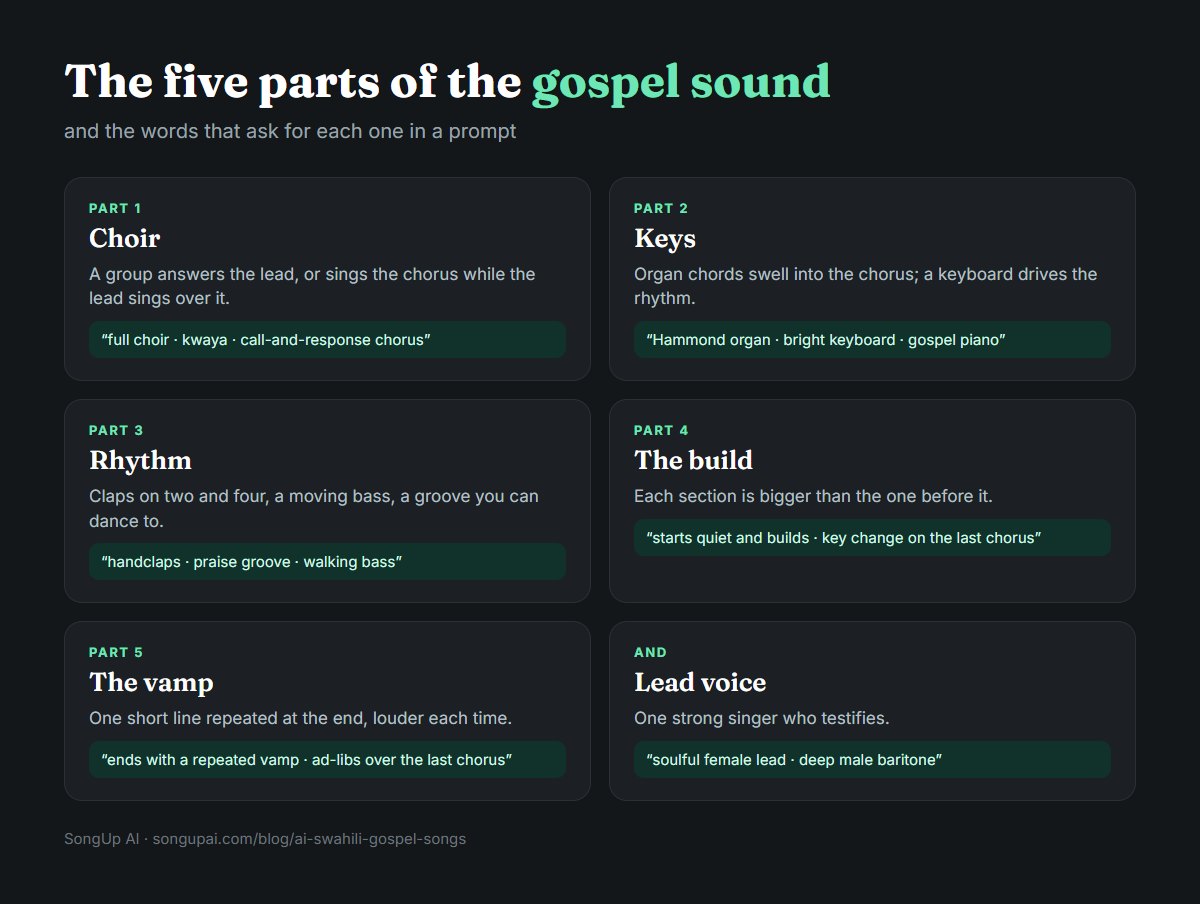
Gospel is a sound before it is a set of words. Five things carry most of it, and each one has words you can put straight into a prompt.
| Part of the sound | What you hear | Words that ask for it |
|---|
| Choir | A group answering the lead, or singing the chorus while the lead sings over it | "full choir", "kwaya", "call-and-response chorus", "choir harmonies" |
| Keys | Organ chords that swell into the chorus; keyboard driving the rhythm | "Hammond organ", "bright keyboard", "gospel piano" |
| Rhythm | Claps on two and four, a moving bass, a groove you can dance to | "handclaps", "praise groove", "walking bass", "upbeat" |
| Build | Each section bigger than the one before | "starts quiet and builds", "key change on the last chorus" |
| Vamp | One short line repeated at the end, louder each time | "ends with a repeated vamp", "ad-libs over the last chorus" |
| Lead voice | One strong singer who testifies | "soulful female lead", "deep male baritone", "powerful lead" |
Swahili praise songs often add bright, ringing electric guitar lines, the kind heard across East African popular music, over the keyboard. Ask for it by name: "bright East African guitar" or "rumba-style lead guitar". Slow worship songs (nyimbo za kuabudu) drop the claps and the guitar and keep a soft keyboard pad, a gentle beat and a voice close to the microphone.
How to make a Swahili gospel song on SongUp AI
You need one idea, a style and the language. The whole thing takes a few minutes.
- Write what the song is about. One true story or one line of faith beats ten general words of praise: "thanks to God for a new morning after my mother's illness", "a song for our church choir's 25th anniversary", "grace that found me when I had given up".
- Name the style and the instruments. For example: "joyful Swahili praise song, keyboard, bright guitar, choir and handclaps, call-and-response chorus".
- Pick the voice. Female, male or a duet. Gospel prompts work best when they also say how the lead sings: "soulful", "powerful", "gentle".
- Set the language to Swahili. On the create page open the Language setting and choose Swahili. You can also write the prompt in Swahili.
- Listen, then change one thing. If the result is too slow, add a tempo ("about 120 BPM"). If the choir is missing, ask for it at the start of the prompt, not at the end. Our AI song prompts guide explains why changing one part at a time works.
Make a gospel song on SongUp AI
What you get depends on your account. A free account gets a finished song from the SongUp AI library that matches your idea, in your language. A paid plan composes a brand-new song from your exact prompt, and that is where every word of a gospel prompt counts. Plans are on the pricing page.
Six prompts for African gospel styles
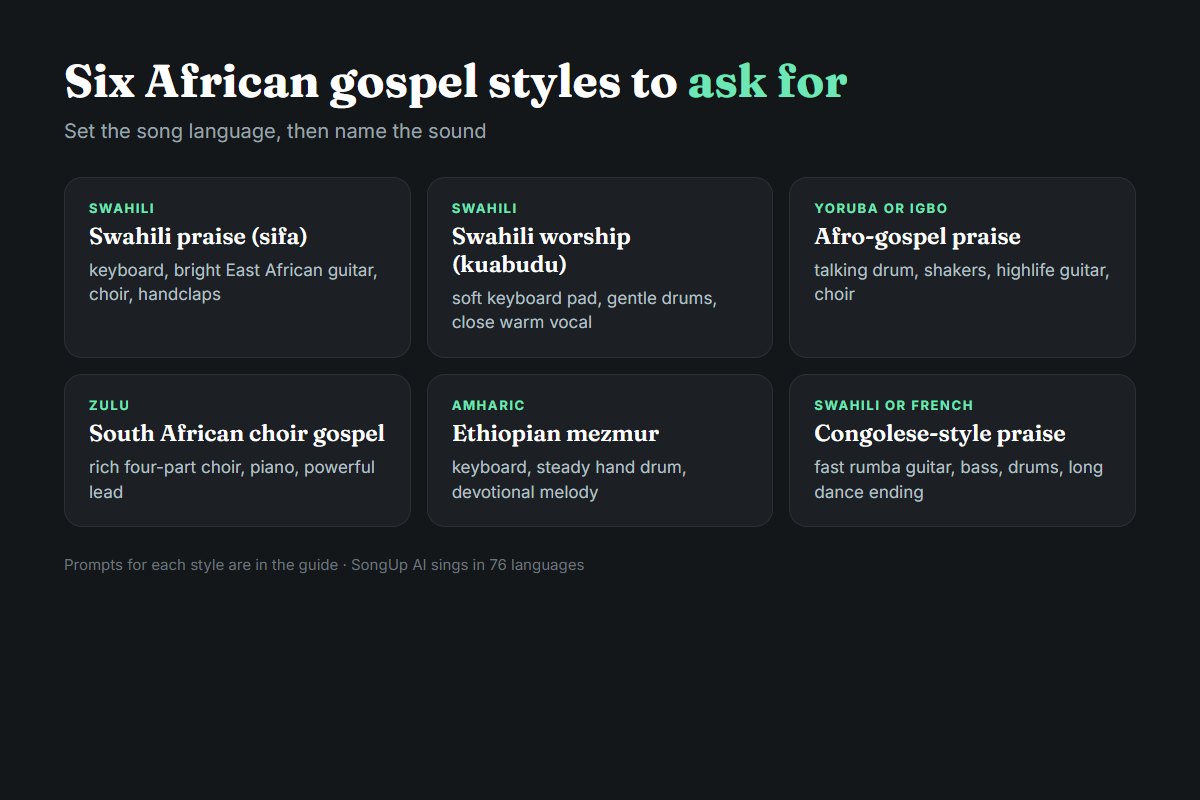
Copy a prompt, change the story to yours, and set the language to match. Each one names a style, the instruments, the voice, the song's subject and its shape.
| Style | Language to set | Prompt to copy |
|---|
| Swahili praise (sifa) | Swahili | Joyful Swahili gospel praise song, keyboard, bright East African guitar, full choir and handclaps, a bright female lead, call-and-response chorus, lyrics thanking God for a new morning, about 120 BPM |
| Swahili worship (kuabudu) | Swahili | Slow Swahili worship song, soft keyboard pad and gentle drums, a warm male vocal close to the microphone, simple chorus a congregation can sing, lyrics about resting in God's peace, builds to a full choir on the last chorus |
| Afro-gospel praise | Yoruba or Igbo | Nigerian Afro-gospel praise song, talking drum, shakers, highlife guitar and a choir, an energetic male lead, dance-ready call-and-response chorus giving thanks, ends with a repeated vamp |
| South African choir gospel | Zulu | South African choir gospel, rich four-part choir harmony, piano, a powerful female lead, slow start that builds to a joyful chorus, lyrics about hope after a hard year |
| Ethiopian mezmur | Amharic | Ethiopian Orthodox-inspired mezmur, keyboard and steady hand drum, a devotional male voice, a slow melody that rises in the chorus, lyrics of thanks and praise |
| Congolese-style praise | Swahili or French | Upbeat Congolese-style praise song, fast rumba guitar lines, bass and drums, a choir answering a male lead, a long dance section at the end, lyrics celebrating God's faithfulness |
Each language has its own page if you want to hear what SongUp AI sounds like in it first: Yoruba, Igbo, Zulu and Amharic.
Prompts for family occasions work the same way. "Swahili gospel song for my mother Neema's 60th birthday, choir and keyboard, lyrics thanking her for praying for every one of us" gives the song a name, an occasion and one true detail, which is all it needs.
How to write gospel lyrics in Swahili
You can let the AI write the words from your prompt, or write them yourself. Writing them yourself is the best way to get the exact testimony and the exact Bible verse you want.
Give each verse one part of the story. Where you were, what happened, what changed. Gospel songs often say "I" (mimi) because the singer is testifying; worship songs often say "we" (sisi) so the whole church sings together.
Keep the chorus short. Four lines at most, in plain words, so a room can sing it back after one listen. Repeating a line is not a weakness in gospel; it is how the chorus becomes a vamp.
Use the words your church already sings. Short words people know carry a chorus: Asante (thank you), Bwana (Lord), Yesu, sifa (praise), neema (grace), Mungu (God), Haleluya. Here is a chorus of our own you can start from:
Asante Yesu, asante Bwana,
umenitendea mema.
Asubuhi hii mpya,
nitaimba sifa zako.
(Thank you Jesus, thank you Lord, you have done good things for me. This new morning, I will sing your praise.)
Using scripture? Quote a short verse and say where it comes from, or put it in your own words. Most Bible translations are fine to quote briefly; check the translation's own notice before you print long passages.
No words yet? Open the AI Lyrics Generator, choose Gospel as the genre and Hopeful as the mood, open "More options" and set the language to Swahili. A free account can write 15 sets of lyrics a day, and the lyrics can be sent straight to the studio to be sung. Paste words you already have into Lyrics to Song and they are sung as written. Composing a song from your own words is part of a paid plan, as is the Write Lyrics option on the create page.
Before you sing it in front of the church, read the lyrics aloud once, slowly. The AI sings exactly what is written, so a missing letter or a word split across two lines will be sung that way too.
What gospel songs people make on SongUp AI
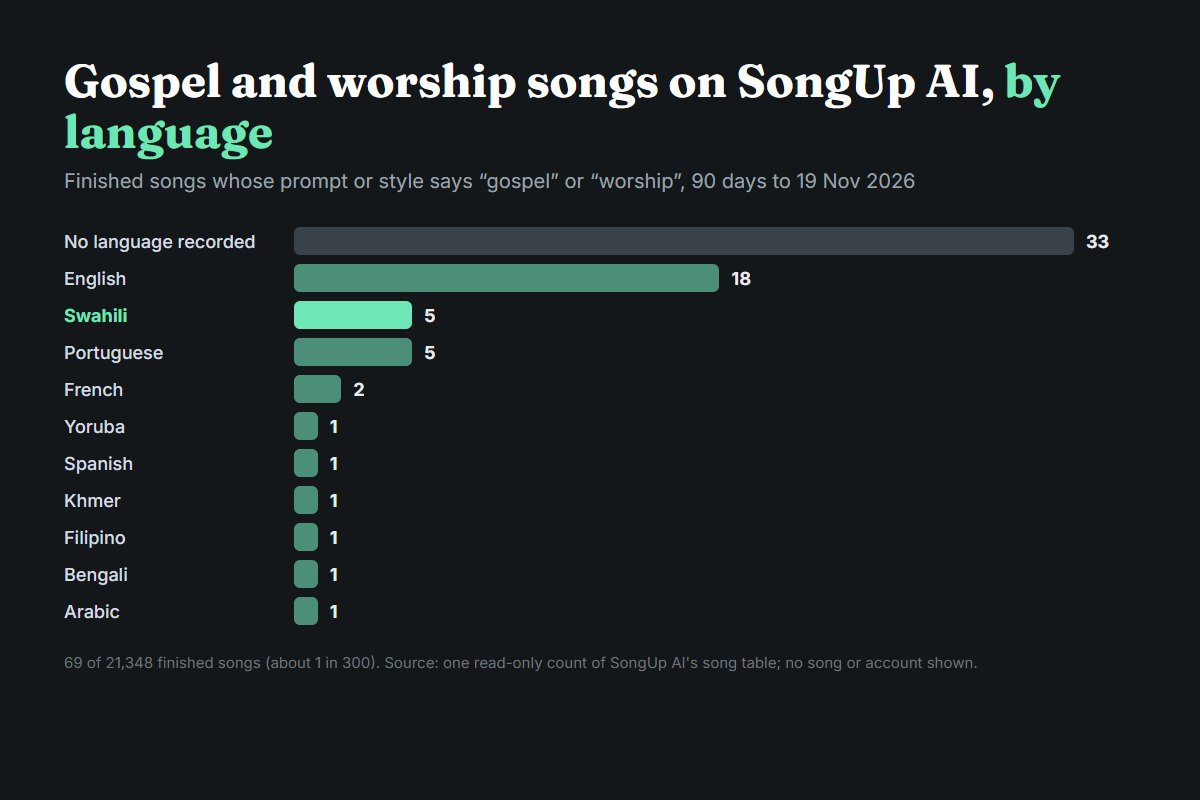
We counted the finished songs made on SongUp AI in the 90 days to 19 November 2026 whose prompt or style tags say "gospel" or "worship" (one read-only count of our own song table; no song or account is shown).
| Song language | Gospel or worship songs | Asked for a choir |
|---|
| No language recorded | 33 | 1 |
| English | 18 | 9 |
| Swahili | 5 | 1 |
| Portuguese | 5 | 1 |
| French | 2 | 1 |
| Yoruba, Spanish, Khmer, Filipino, Bengali, Arabic | 1 each | 1 (Spanish) |
| All | 69 | 14 |
Three things stand out.
- Gospel is a small share of all songs. 69 of 21,348 finished songs, about one song in 300. People who make one usually have one clear reason: a church event, a parent, a hard year.
- Swahili is second among named languages, level with Portuguese and ahead of French, Spanish and every other language except English.
- Most gospel prompts never mention a choir. Only 14 of the 69 did, and only 1 of the 33 with no language set. A choir is the single biggest part of the gospel sound, so if you want one, say so at the start of the prompt.
Using the song in church and online
Backing tracks for the choir. The Karaoke Maker takes the lead vocal out of a song so the choir or a soloist can sing over the band. Find the key and tempo for the musicians with the Key & BPM Finder in the free tools.
Projecting the words. Your song's lyrics are on its page in your library; copy them into your church's slides.
Who owns it. A song you make on SongUp AI is a new, original song, not a cover. Songs made on a paid plan, or bought on their own, come with commercial rights and a certificate of ownership, so you can sing them in church, post them and release them. Songs made on the free tier are for personal, non-commercial use. The details are in the Terms of Service (checked 19 November 2026).
Hymns you did not write. Old hymns are often in the public domain and free to sing and record in new arrangements. Most modern worship songs are still under copyright, which is why many churches hold a song licence to sing and project them. For songs written in your own words, and how a church uses them, see how to turn your own lyrics into a worship song.
Hear a gospel sound we made. The Alabama state song page plays "Sweet Home Under Southern Pines", a Southern anthem with Hammond organ, handclaps and a church-choir chorus, made with the same music engine. It is in English, but listen for how the choir and organ sit under the lead.
AI Swahili gospel songs: FAQ
Can AI make gospel songs in Swahili?
Yes. On SongUp AI you choose Swahili as the song language, describe the song (for example a joyful praise song with choir, keyboard and guitar) and the AI writes and sings it in Swahili. It works the same way for Yoruba, Igbo, Zulu, Amharic and 70 more languages.
Is there a free AI Swahili gospel song generator?
The lyrics part is free: the AI Lyrics Generator writes gospel lyrics in Swahili, up to 15 sets a day on a free account. On the create page a free account gets a finished song from the SongUp AI library matched to your idea and language; a new song composed from your own prompt or words is on a paid plan.
How do I get a choir in an AI gospel song?
Say it near the start of the prompt: "full choir", "kwaya" or "choir answering the lead, call-and-response chorus". Add "builds to a full choir on the last chorus" if you want the choir to come in late. In our own numbers, most gospel prompts never ask for a choir at all.
Can I use my own Swahili lyrics?
Yes. Paste them into Lyrics to Song or use Write Lyrics on the create page, set the language to Swahili, and the AI sings them as written. Read them aloud first: spelling mistakes are sung too. Composing a new song from your own words is part of a paid plan; the pricing page shows what applies where you are.
What are nyimbo za injili?
"Nyimbo za injili" is Swahili for gospel songs (nyimbo means songs, injili means the gospel). People also say "nyimbo za kuabudu" for worship songs and "nyimbo za sifa" for praise songs. All three work as words in a SongUp AI prompt.
Can we sing an AI gospel song in church?
Yes. A song you make is new and original. Songs made on a paid plan or bought on their own carry commercial rights, so you can also post and release them. Free-tier songs are for personal, non-commercial use; check the Terms of Service.
Which other African languages can AI gospel songs be sung in?
On SongUp AI: Swahili, Yoruba, Igbo, Hausa, Zulu, Afrikaans, Amharic, Tigrinya, Somali and more, among 76 song languages in all. Each has its own page, listed on the languages page.