AI Music Statistics 2026: Uploads, Streams, Listeners, Lawsuits, and 12,447 Real Song Requests
S
SongUp Team
SongUp AI Team
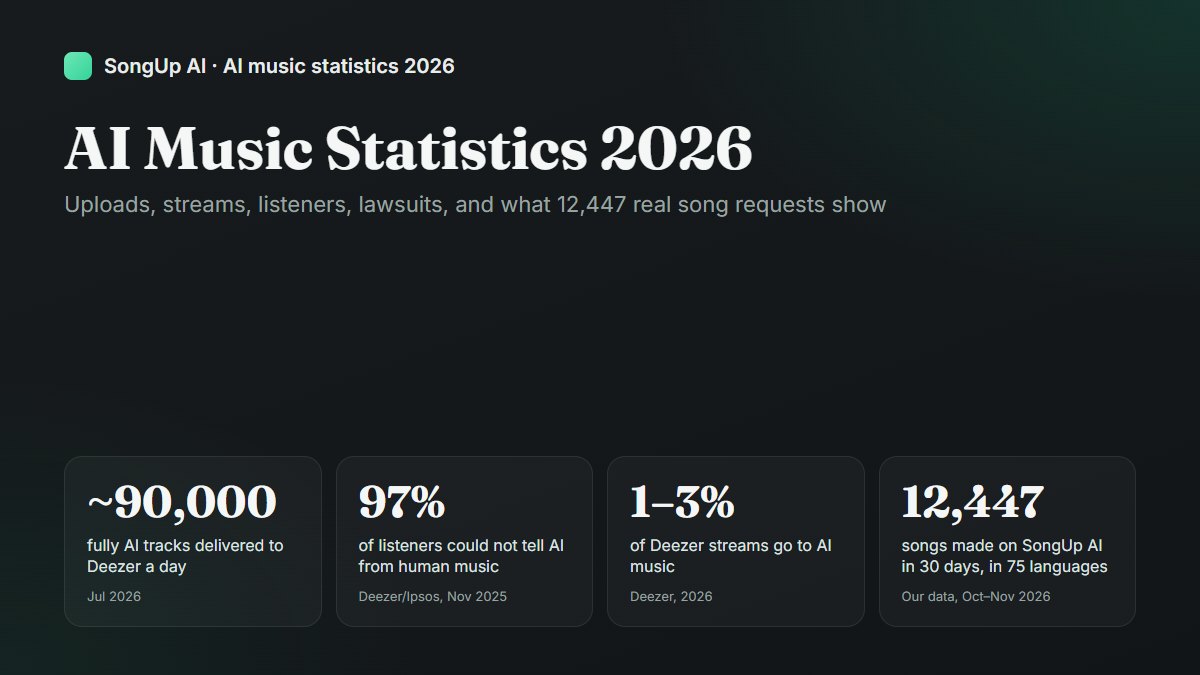
In 2026, about 90,000 fully AI-generated tracks reach Deezer every day, more than half of all new uploads on peak days, yet AI music gets only 1% to 3% of streams there, and Deezer found up to 85% of the plays on fully AI tracks were fake. 97% of listeners could not tell an AI song from a human one in a blind test, while 80% want AI music labelled. Suno says it has 2 million paying subscribers, Universal and Warner have settled with Udio and Warner with Suno, while Sony, Universal and GEMA keep suing.
Every number below has its source and date next to it, checked in November 2026. The second half is new: what 12,447 songs people made with SongUp AI in 30 days show about why people make AI music at all. Hardly anyone uploads them. They write love songs, songs for their mother and songs for friends, and 99% of them stay private.
In short
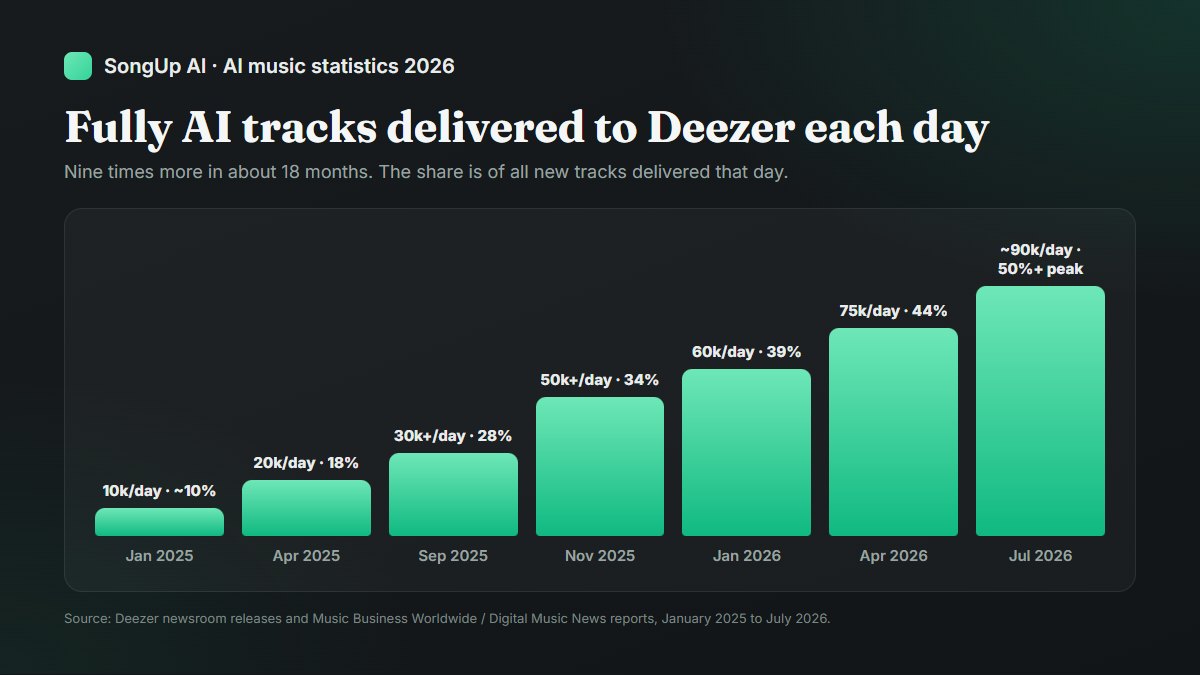
Uploads: Deezer gets about 90,000 fully AI tracks a day, up from about 10,000 in January 2025, and over 50% of all new tracks on peak days.
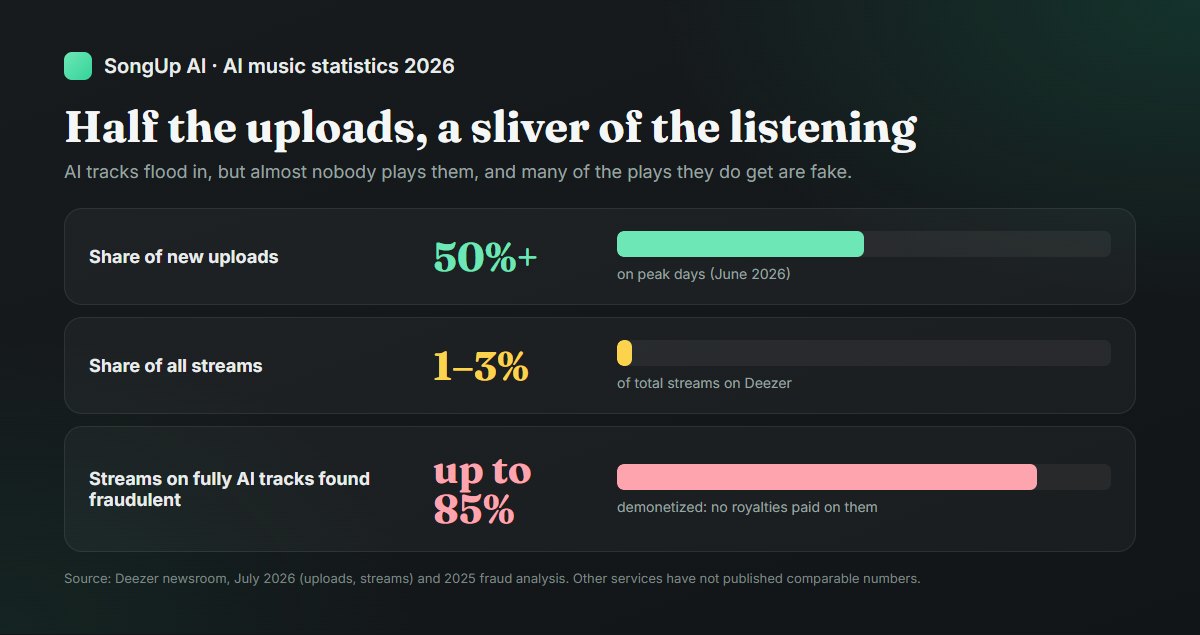
Listening: AI music is only 1% to 3% of streams on Deezer, and up to 85% of the streams on fully AI tracks were fraudulent in 2025.
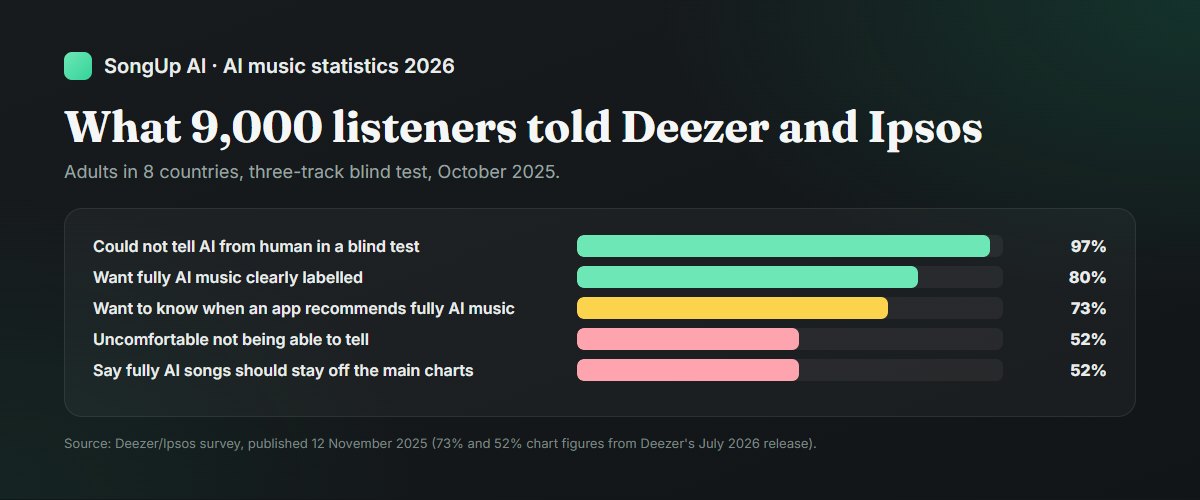
Listeners: 97% couldn't tell AI from human music in a three-song test; 80% want fully AI tracks labelled.
Companies: Suno reported 2 million paying subscribers and $300 million in yearly revenue (February 2026) and was valued at $5.4 billion in June 2026.
Courts: UMG settled with Udio, Warner with Udio and Suno; Sony, UMG and GEMA kept suing, and a Munich court ruled against Suno in July 2026.
Our data: of 12,447 songs made on SongUp AI in 30 days, the most common subject was love (18%), then parents and friends, the median description was 49 words, and only 0.7% were made public.
AI music statistics 2026: the key numbers
The table puts each number in one place with who measured it and when. "Reported" means a news outlet reported the figure and we could not open the original; everything else was checked on the publisher's own page.
The rest of the article explains each line: what was measured, what it doesn't say, and how the numbers fit together.
How many AI songs are uploaded every day
Deezer is the only big streaming service that publishes a regular count of fully AI-generated uploads, because it runs its own AI detector and tags every fully AI track it catches. That makes Deezer's numbers the standard reference for "how much music is AI", and the trend is steep.
January 2025: about 10,000 fully AI tracks a day, roughly 10% of deliveries, when Deezer turned its detector on.
September 2025: more than 30,000 a day, 28%.
November 2025: more than 50,000 a day, 34%.
April 2026: about 75,000 a day, 44%, or more than 2 million a month.
June 2026: nearly 90,000 a day, and more than half of all new tracks on peak days. Deezer tagged 13.4 million AI tracks over 2025.
Other counts point the same way. SubmitHub ran its own detector over more than a million releases from July 2026 and said 38.5% involved AI: 23.2% fully generated and 15.3% changed with AI, as Euronews reported. That's a different method and a different set of songs, so it won't match Deezer's number exactly, but both say the same thing: a large share of new music is now made with AI.
Read it carefully
"Half of uploads" is not "half of music".
The count is of new tracks delivered in a day, not of the catalogue or of what people listen to. A small number of accounts uploading thousands of tracks each can move it a lot. The next section shows how little of that music anyone plays.
Uploads vs streams: how much AI music people actually play
This is the gap most AI music statistics leave out. On Deezer, AI tracks are half the new uploads but only 1% to 3% of all streams. And many of those streams aren't real people: in 2025, Deezer found that up to 85% of the streams on fully AI tracks were fraudulent, against 8% across its whole catalogue.
The pattern behind the numbers is a known scheme: upload thousands of cheap AI tracks, then play them with bots to collect royalties. Deezer's answer is to keep fully AI tracks out of its algorithmic recommendations and editorial playlists and to pay nothing on streams it finds to be fraudulent. Deezer says its detector is 99.8% accurate, its own figure.
So, in plain terms:
Most AI tracks on streaming services have almost no human listeners.
The money doesn't follow the uploads. Fraudulent streams are removed before royalties are paid.
The real AI music audience is elsewhere: in songs made for one person, one video or one moment, which never reach a streaming service at all. Our own data below shows what those look like.
If you do want to release AI songs and be paid, the rules on fake streams, thresholds and distributors are in our guide on how to make money with AI music.
Spotify AI music statistics
Spotify publishes fewer AI counts than Deezer, but its numbers on spam are large:
75 million+ spam tracks removed in the 12 months to September 2025, spam of every kind, not only AI (Spotify).
50 million+ "slop" and spam tracks taken out of recommendations in 2026 (Spotify, 20 October 2026).
Tracks likely to be AI-generated are 10 times more likely than other tracks to stay under the 1,000-stream yearly threshold that a track needs before it earns anything.
300,000+ verified artists, more than 70% of them independent, under the "Verified by Spotify" badge that started on 30 April 2026.
Spotify's AI steps in 2026, in order: AI credits shown in song credits (April), the "Verified by Spotify" badge (30 April), and labels for "AI personas", artists who are wholly AI, whose music is left out of recommendations by default (11 August). Since September 2025 it has also had a policy against voice-clone impersonation and supports a common industry standard for declaring AI use in song credits.
Can people tell AI music from human music?
Mostly not. In the survey Ipsos ran for Deezer in October 2025, 9,000 adults in eight countries heard three tracks and were asked which were AI. 97% got it wrong, and more than half said that made them uncomfortable.
Do people like AI music? The answers depend on who is asked:
Listeners want labels. 80% want fully AI music clearly labelled, 73% of streaming users want to know when a service recommends it, and 52% say fully AI songs shouldn't be in the main charts (Deezer/Ipsos).
US adults lean against it. Among adults who know about AI music, 38% say AI makes them less interested in a song and 28% more interested (Luminate, reported by Music Ally).
Musicians are split, and younger ones use it. 54% of US musicians are positive about AI music tools, against 35% of non-musicians, and 18% already use AI to edit or remix (Luminate, July 2026). In the UK, 79% of PRS members are worried AI music will compete with theirs, up from 74% in 2023.
In Germany and France, 35% of music creators used AI already in 2023 (51% of those under 35), while 71% feared it would cost them income (Goldmedia for GEMA and SACEM).
How many people use AI music generators?
No one publishes a total, but the companies' own figures give a sense of scale:
Suno said in February 2026 that it had 2 million paying subscribers and $300 million in yearly revenue, and that more than 100 million people had used it. In October 2026 its CEO said it was "far beyond" those numbers without giving new ones (MBW). It raised $250 million at a $2.45 billion valuation in November 2025 and more than $400 million at $5.4 billion in June 2026.
Udio has not published user numbers.
All AI music tools together, counting generators and stem-splitters, made about $333 million in 2025, 651% more than in 2023, with 63 million monthly users, according to the IMS business report written by MIDiA Research.
For how the main generators compare on features and price, see our best AI music generators guide, or the head-to-heads with Suno and Udio.
How big is the AI music market?
Forecasts differ by what they count, so compare like with like:
Goldman Sachs "Music in the Air", Oct 2026, reported by Digital Music News
For scale: the whole recorded music industry made $31.7 billion in 2025 (IFPI). So by these forecasts, AI music providers would make roughly an eighth of what recorded music made in 2025, while taking a much larger share of creators' income.
AI songs on the charts
November 2025: "Walk My Walk" by the AI act Breaking Rust reached No. 1 on Billboard's Country Digital Song Sales chart, and Billboard counted at least six AI acts on its charts in the months before (ABC News).
Autumn 2025: Xania Monet, an AI R&B singer whose lyrics are written by a human poet, became the first known AI act on a Billboard radio chart (No. 30, Adult R&B Airplay), as Billboard reported.
First half of 2026: the highest AI-assisted song on Luminate's global chart was "Papaoutai (Afro Soul)" at No. 282, with 210.7 million streams.
August 2026: Australia's ARIA charts said wholly AI-generated songs would no longer be eligible.
So AI songs can chart, mostly on sales charts in small genres, and the charts are now writing rules to keep wholly AI songs out.
AI music lawsuits and settlements
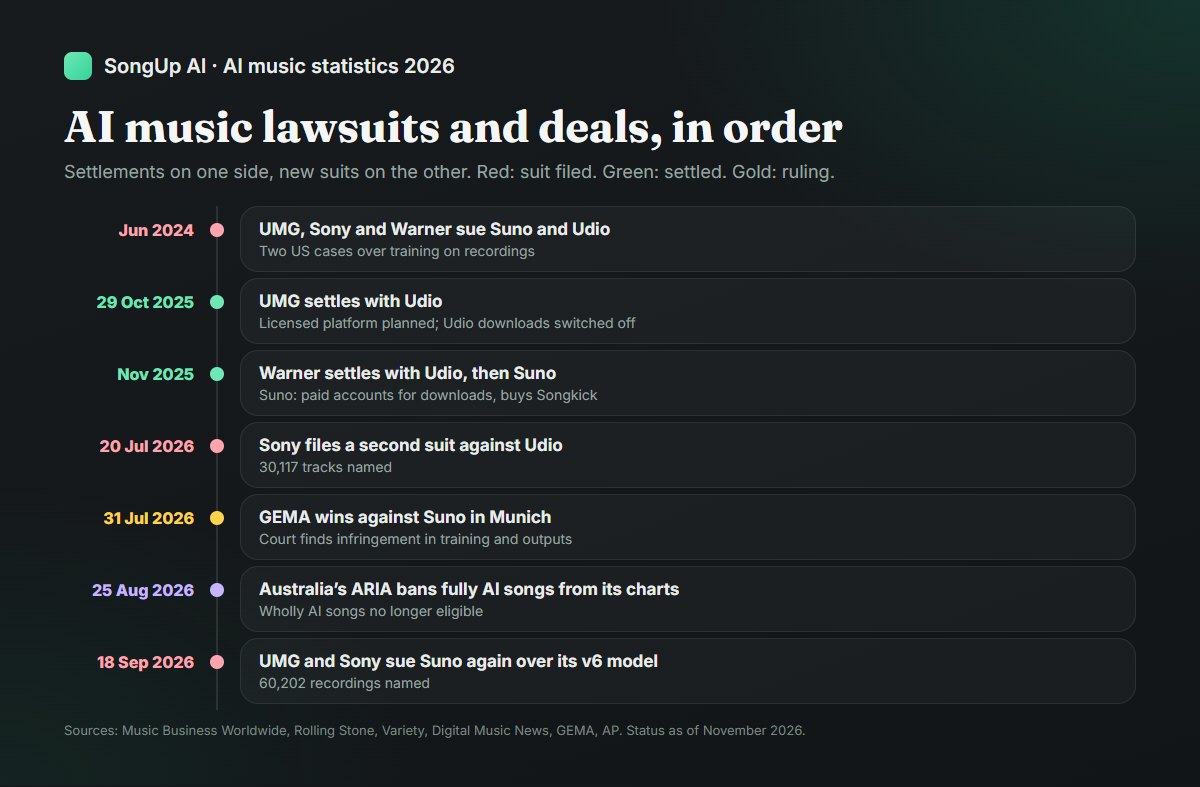
The record labels sued Suno and Udio in June 2024. Since then the story has split: some labels made deals, and others kept suing.
29 October 2025: Universal settled with Udio and agreed to build a licensed platform together; Udio switched off downloads.
November 2025: Warner settled with Udio, then with Suno, which bought the concert site Songkick and said downloads would need a paid account.
20 July 2026: Sony filed a second suit against Udio naming 30,117 tracks, Variety reported.
31 July 2026: a Munich court ruled for GEMA against Suno, finding infringement in both the training and the songs it produced, and said Suno must pay licence fees (GEMA).
18 September 2026: Universal and Sony sued Suno again over its v6 model, naming 60,202 recordings (Digital Music News).
What these cases mean for your own songs, whether you can use them in videos, sell them or copyright them, is in our AI music copyright guide.
Labels on AI music: what each platform asks
Platform
What it does with AI music
Deezer
Tags fully AI tracks for listeners, keeps them out of algorithmic and editorial recommendations
Spotify
AI credits in song credits, "AI persona" labels, wholly AI artists left out of recommendations by default
YouTube
Creators must disclose realistic AI content, and AI-generated music is one of its examples (YouTube Help)
TikTok
Creators must label realistic AI content; content from other apps is labelled automatically when it carries Content Credentials (TikTok)
Apple Music
AI "transparency tags" set by the label or distributor, not shown to listeners; reported to become mandatory where AI made a material part of a track
If you make a song for a video or a client, keep the proof of where it came from. Our AI music commercial license guide explains the certificate every paid SongUp AI song comes with.
What 12,447 real song requests show
The numbers above are about AI music on streaming services. They miss most of the people who make AI songs, because those people never upload anything. To show that side, we counted every song composed on SongUp AI in 30 days, from 12 October to 10 November 2026: 12,447 new songs in 75 languages, about 415 a day. No other AI music statistics page has this, because it comes from our own records.
Only 1,332 of those songs were in English, the third language after Persian and Arabic. Which languages people make songs in, with a table for every language, is on our separate AI music by language data page, so this article doesn't repeat it.
People write a lot, and say the style in words
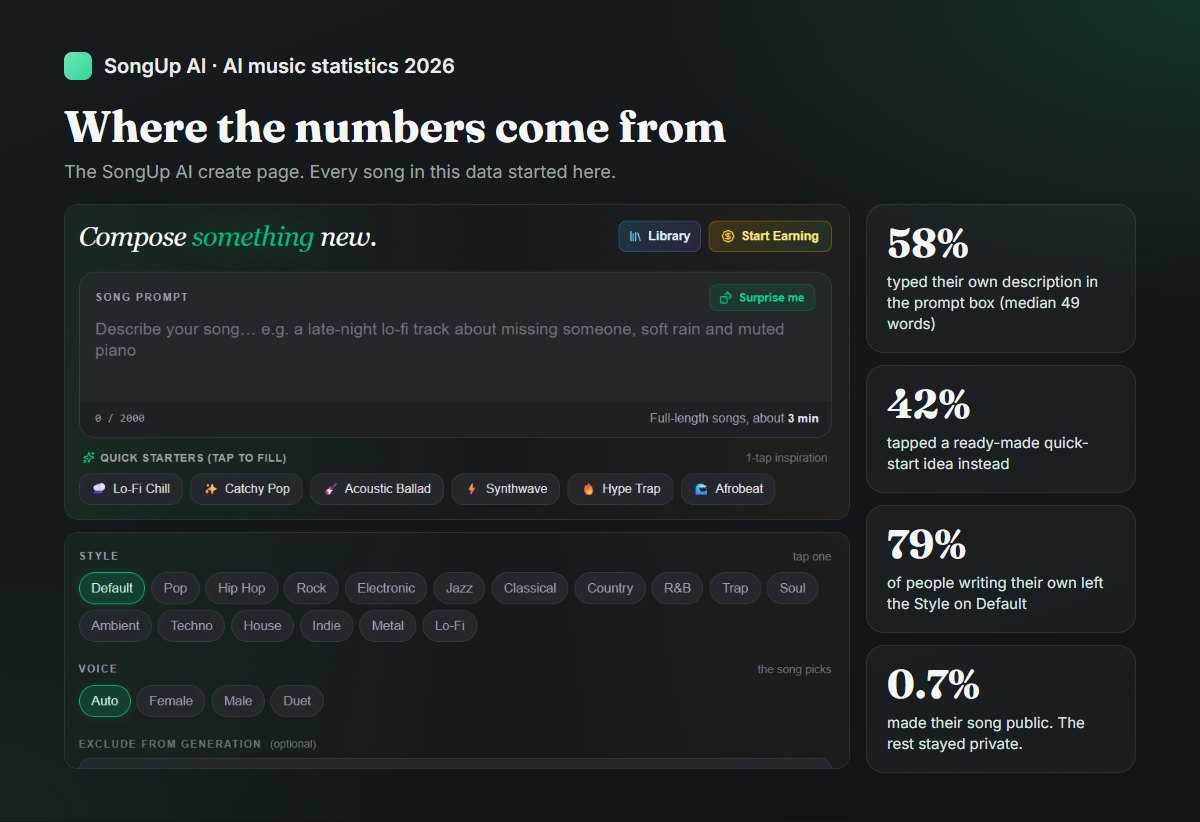
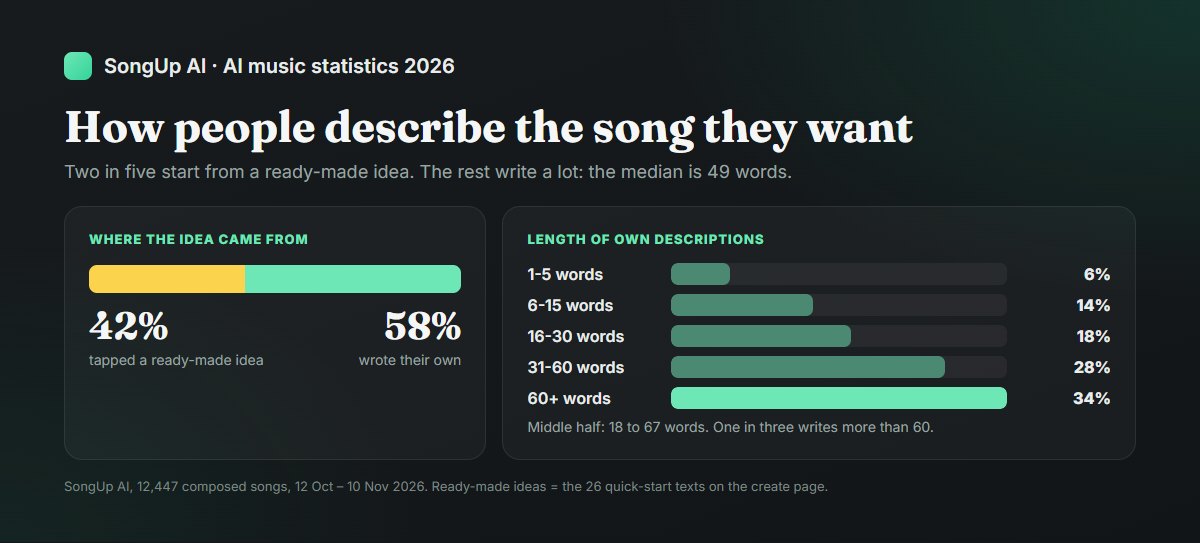
When people wrote their own description instead of tapping a ready-made idea, they wrote more than you'd expect: a median of 49 words, and one in three wrote more than 60. Only 6% wrote five words or fewer. They aren't typing "sad song"; they're telling a story: who it's for, what happened, what it should feel like.
The other 42% tapped one of the quick-start ideas on the create page, such as Lo-Fi Chill or Catchy Pop. If you want to write your own, our AI song prompts guide has 40 examples.
Most people never press a genre button
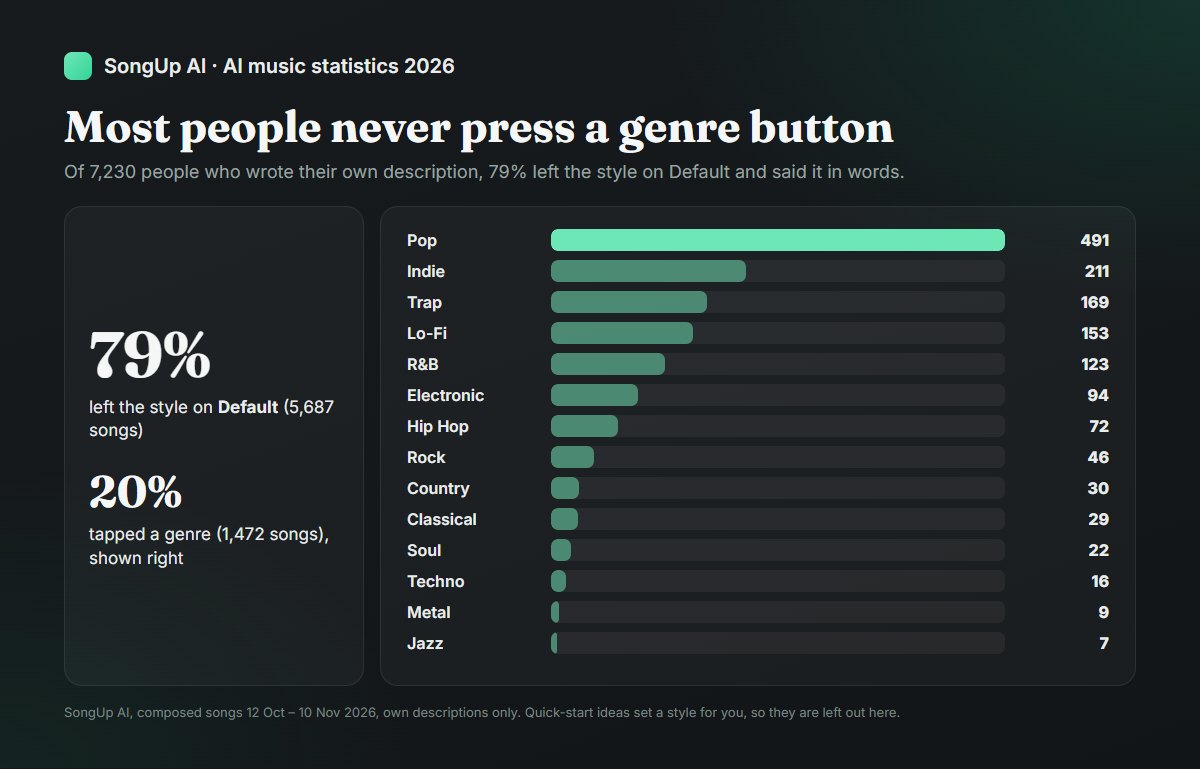
Among the 7,230 songs described in people's own words, 79% left the style on Default and described the sound in the text instead ("like an old Bollywood song", "soft guitar, like a lullaby"). Of those who did choose a genre, Pop led by far, then Indie, Trap, Lo-Fi and R&B. Jazz, Metal and Techno were picked fewer than 20 times each.
What people make songs about
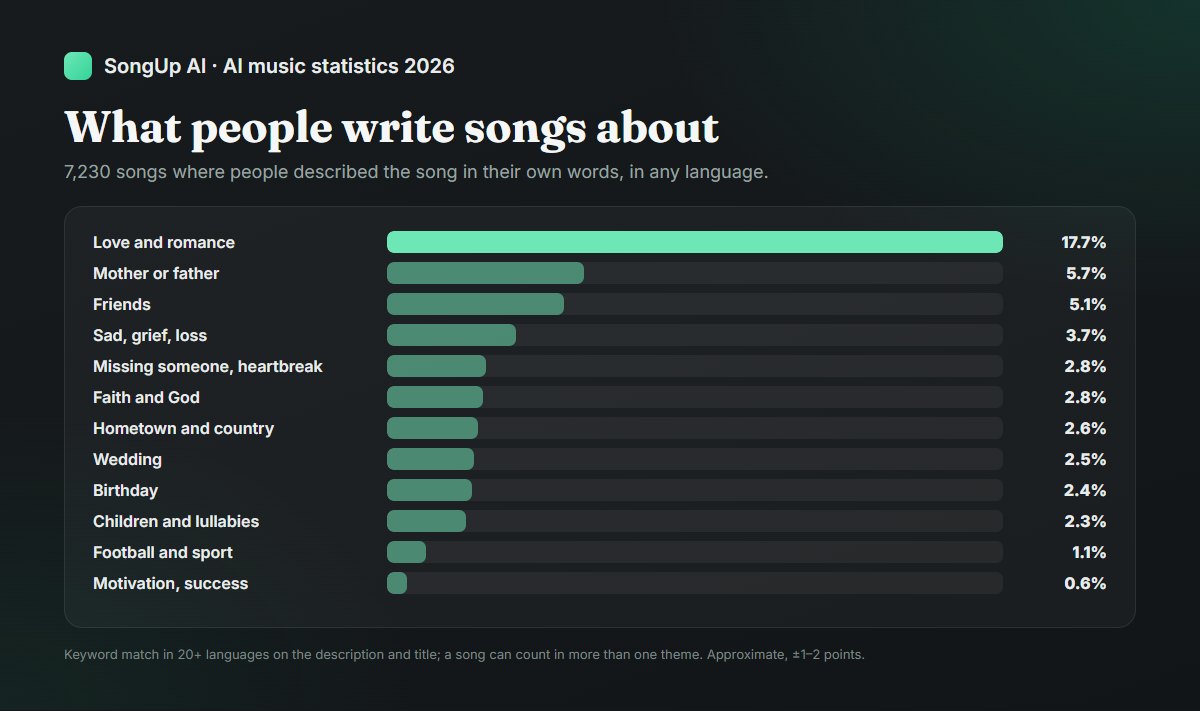
We matched keywords in more than 20 languages against each description and title. The results are approximate (a song can count twice, and a keyword can miss), but the order is clear: love comes first by a wide margin, then songs about a mother or father, and songs for friends.
A few things stand out:
Songs are personal. Love alone is about one in six descriptions, and the next themes are parents, friends, weddings, birthdays and children: songs about people, not about a mood.
Grief is a real use. About 1 in 25 descriptions is about loss, someone who died, or sadness: the kind of song people make as a memorial song.
Motivation and success, the classic "stock music" themes, are almost absent at 0.6%.
Christmas had barely started. Christmas and New Year appeared in no descriptions in the first two weeks, then 1, 2 and 5 a week by 10 November. Expect that to rise through December.
The finding
The streaming numbers count AI songs made for nobody. Ours count songs made for someone.
Only 87 of 12,447 songs (0.7%) were made public. The rest were kept private, sent to one person or played at one event. That kind of AI music never shows up in an upload count.
When people make songs
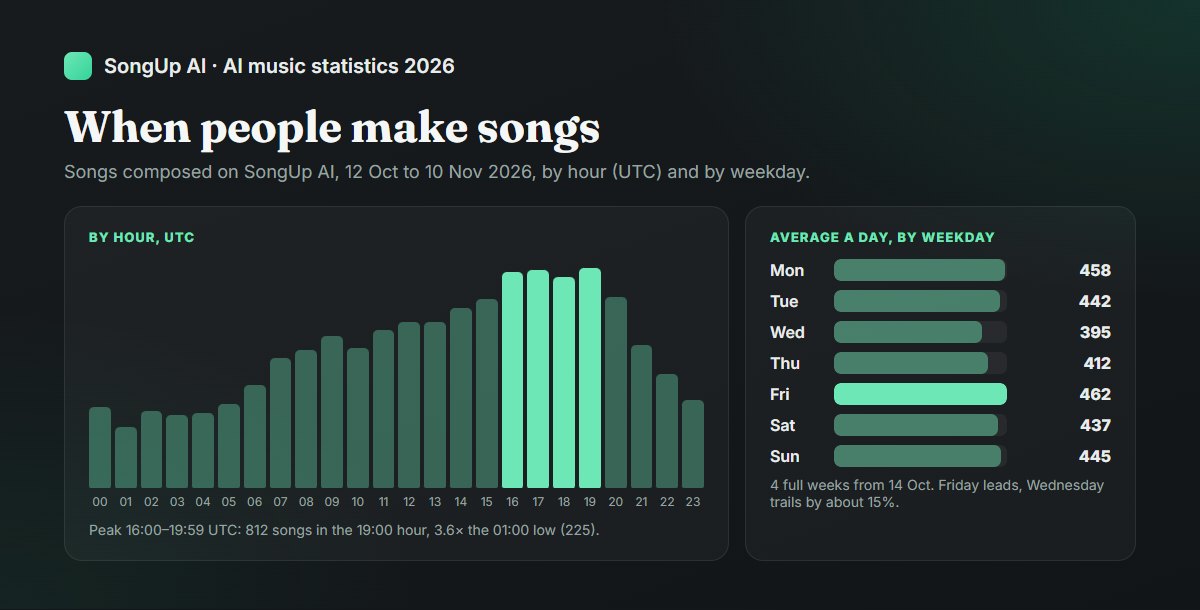
The busiest hours were 16:00 to 20:00 UTC, which is evening in Iran, the Gulf, Pakistan and India, and lunchtime in the Americas. The 19:00 hour had 812 songs over the month, 3.6 times the quietest hour (01:00 UTC, 225 songs). Across the week the differences were small: Friday was busiest, about 15% above Wednesday.
Other numbers from the month
Vocal songs are the norm: 12,141 of 12,447 (98%) were full songs with vocals. About 330 were instrumentals, 26 started from humming (hum to song), and a handful from a photo.
Length: the median song was 3 minutes long, and 95% were between 3 and 4 minutes.
Free library matches: another 2,061 songs went to free accounts as a match from our existing song library rather than a new song, so they are not counted above.
Busiest day: 30 October 2026, with 606 new songs.
The typical request, sung
To show what an average request sounds like, we wrote one to match the data: a love song, Pop, in a 58-word description close to the median, with the details people actually put in (how they met, a running joke, a yearly habit). This is what came back.
The most common request · Love song · Pop · 2:48
Every October
for a tenth anniversary: they met in the rain at a bus stop, and he still burns the rice
The description (58 words): Warm mid-tempo pop love song, acoustic guitar and soft piano, light handclaps in the chorus, gentle build to a big final chorus, about 92 BPM. For our tenth anniversary: we met when it rained at a bus stop in October, she still laughs at my terrible cooking, and every year we dance in the kitchen to the radio.
Made with SongUp AI for this article, with our own lyrics. The couple is an example; yours gets your names and your story.
Industry numbers: every figure was checked in November 2026 against the publisher's own page where it could be opened. Where only a news report was available, the table says "reported" and links to it. When two pages from the same publisher disagreed, we used the newer one: Deezer's April 2026 release says "up to 70%" fraudulent streams in one place, and its July release says up to 85%.
SongUp AI numbers: all songs that finished between 12 October and 10 November 2026 (UTC), read from our database once, as a whole. "Composed" means a new song made for one account; free library matches are counted separately. Ready-made ideas were found as texts used word for word 15 times or more. Themes are a keyword match in more than 20 languages on the description and title, so treat them as approximate, within a point or two. Descriptions were counted by a script; nobody read people's songs, and nothing here identifies a person.
What our numbers are not: they describe people who use one AI song maker, mostly outside the US, not all AI music. They say nothing about streaming.
Cite this data
Free to use under CC BY 4.0
Use the SongUp AI numbers and charts in articles, reports and AI answers. Please credit SongUp AI and link to this page.
SongUp AI (2026). AI music statistics 2026: what 12,447 song requests show. https://www.songupai.com/blog/ai-music-statistics
For the industry numbers, cite the original source linked in the table, not this page. If you need a SongUp AI figure that isn't here, write to support@songupai.com.
AI music statistics: FAQ
What percentage of music uploads is AI-generated in 2026?
On Deezer, more than 50% of new tracks on peak days in June 2026, about 90,000 a day. That was 44% in April 2026 and about 10% in January 2025. SubmitHub's own check of July 2026 releases found 38.5% involved AI. No streaming service has published a share for its whole catalogue.
How many AI songs are uploaded to streaming services every day?
Deezer, the only service that publishes a daily count, received nearly 90,000 fully AI-generated tracks a day in June 2026. Most songs go to every service at once through a distributor, so other services likely receive a similar number, but they don't publish it.
What share of streams goes to AI-generated music?
About 1% to 3% of all streams on Deezer in 2026. Up to 85% of the streams on fully AI tracks were found to be fraudulent in 2025, so the share of real listening is smaller still.
Can people tell AI music from human-made music?
Mostly not. In a Deezer/Ipsos survey of 9,000 adults in eight countries, 97% couldn't tell which of three songs were AI. 80% said they wanted fully AI music labelled.
How many people use Suno, and how much money does it make?
In February 2026, Suno said it had 2 million paying subscribers, $300 million in yearly revenue and more than 100 million people who had used it. In October 2026 its CEO said it was "far beyond" those numbers. Udio has not published user numbers.
Which record labels have settled with Suno and Udio?
Universal settled with Udio in October 2025. Warner settled with Udio and then Suno in November 2025. Sony has not settled with either; it filed a second suit against Udio in July 2026, and with Universal sued Suno again in September 2026 over its v6 model. In Germany, GEMA won its case against Suno in July 2026.
Has an AI song reached No. 1 on a Billboard chart?
Yes, on a small one. In November 2025, "Walk My Walk" by the AI act Breaking Rust reached No. 1 on Billboard's Country Digital Song Sales chart, which counts downloads, not streams or radio.
What do people make AI songs about?
On SongUp AI, love is the most common subject by far, in about 18% of the songs people described in their own words, followed by songs about a mother or father (6%) and songs for friends (5%). Only 0.7% of songs were made public; most are made for one person.