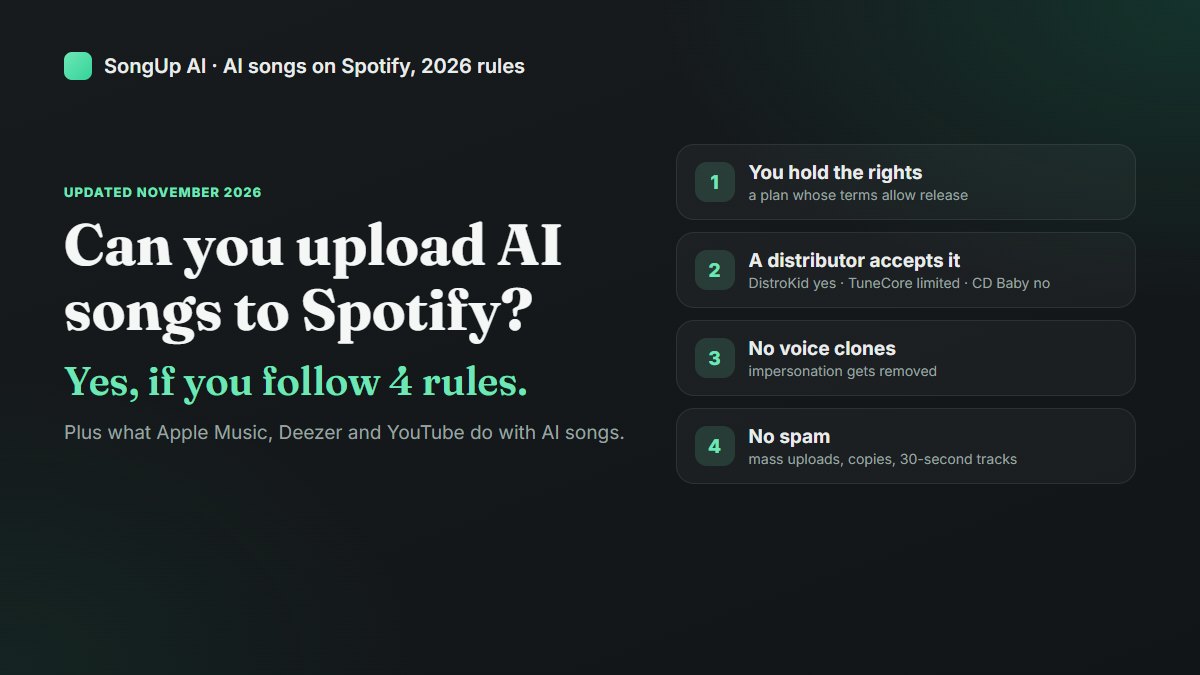
Yes, you can upload AI songs to Spotify in 2026. Spotify does not ban AI music: it removes spam, songs that clone a real singer's voice without permission, and uploads that pretend to be someone else. The catch is everything before Spotify. You need a plan whose terms let you release the song, and a distributor that accepts music from your AI tool, because some don't.
This guide covers each of those checks with the rules as they stand on 11 November 2026: what Spotify's AI policy says, which distributors take AI songs, what Apple Music, Deezer and YouTube do differently, what gets songs removed, and how to prepare a release that stays up. Every rule links to its source, because these rules have changed almost every month since mid-2025.
- Spotify allows AI music. It says it treats all music equally whatever tools made it, and that it won't down-rank a track for disclosing AI use.
- Three things get removed: voice clones of real artists without their permission, spam (mass uploads, near-copies, very short tracks) and deceptive uploads, such as an AI song placed on a real artist's page.
- Your distributor decides first. DistroKid accepts AI songs if you hold the rights. TuneCore takes only music from AI models trained on licensed data. CD Baby is widely reported to reject fully AI-made tracks.
- Your AI tool's terms come before both. Free plans almost never allow release, and Udio has had downloads switched off since October 2025.
- New in 2026: optional AI Credits in Spotify's Song Credits since April, and "AI Persona" badges since September. Profiles with that badge are left out of recommendations by default.
The short answer, question by question
| Question | Answer in November 2026 | Where it's covered |
|---|
| Does Spotify allow AI-generated music? | Yes. It removes spam, impersonation and deception, not AI music as such | Spotify's AI rules |
| Can I upload a song to Spotify myself? | No. Every independent release goes through a distributor | Distributors |
| Do distributors accept AI songs? | DistroKid yes; TuneCore only from licensed models; CD Baby mostly no | Distributors |
| Can I release a song made on a free AI plan? | Almost never. Free plans are for personal use | Your AI tool's terms |
| Do I have to label it as AI? | Spotify: optional AI Credits. Apple Music: becoming required. Deezer tags it for you | Labels |
| Can AI songs earn royalties? | Yes, under the same rules as any song, including the 1,000-stream minimum | Money |
| Can I use an AI voice that sounds like a famous singer? | No. That is the one hard rule | What gets removed |
Can you upload AI songs to Spotify? Yes, if four things are true
Spotify's own position, from its September 2025 policy update, is that artists decide whether to use AI and that all music is treated equally regardless of the tools used to make it. What it acts against is a set of behaviors, not a technology. So the real question isn't "is AI allowed?" but "does my song pass the checks every release goes through?" There are four:
- You hold the rights to release it. That comes from your AI tool's terms and your plan, not from Spotify.
- Your distributor accepts music from that tool. Spotify only takes releases from labels and distributors, and each distributor now has its own AI policy.
- It doesn't imitate a real artist. No cloned voice, no borrowed artist name, no upload to someone else's profile.
- It's a real release, not spam. One finished song, not fifty near-copies or a pile of 31-second tracks.
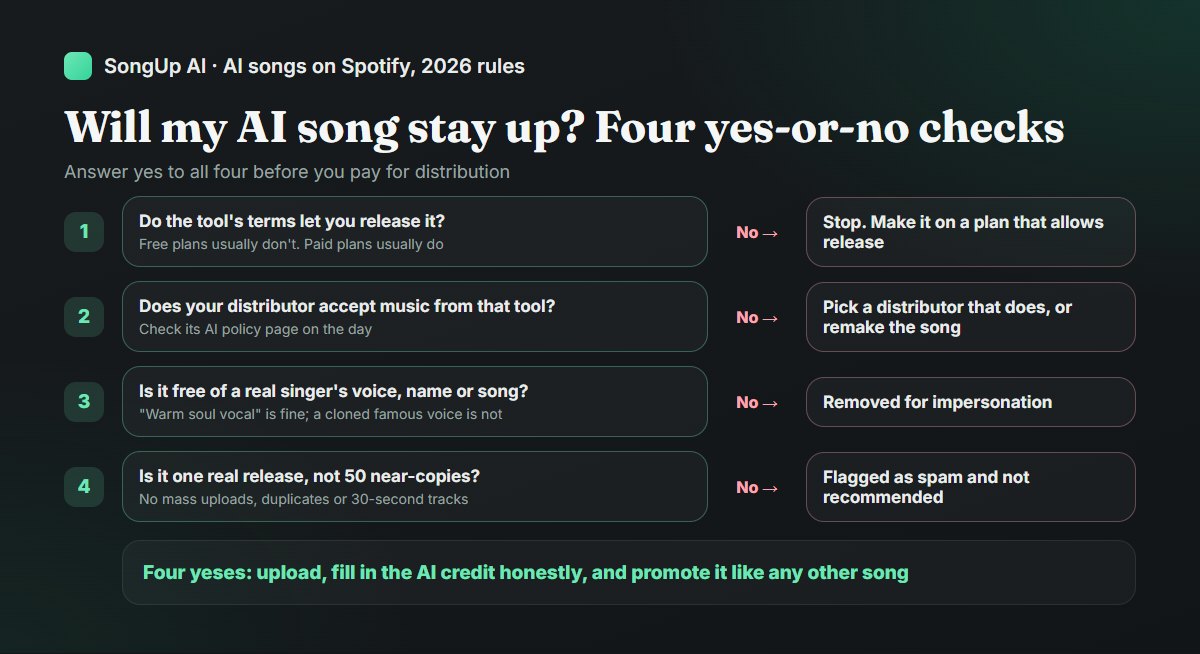
If any answer is no, fix that first. Paying for distribution won't help, because the song will be rejected at upload or removed later, and a removal can cost you more than one song. Distributors can lock a whole account over repeat problems.
What Spotify's AI rules say in 2026
Spotify's AI policy is spread across several announcements. Read together, they come down to three rules and two labels.
The three rules (September 2025):
- Impersonation policy. Vocal impersonation is allowed only when the impersonated artist has authorized it. An AI voice clone of a real singer, released without their permission, gets removed. Spotify also tightened its "content mismatch" process for music delivered to the wrong artist's profile.
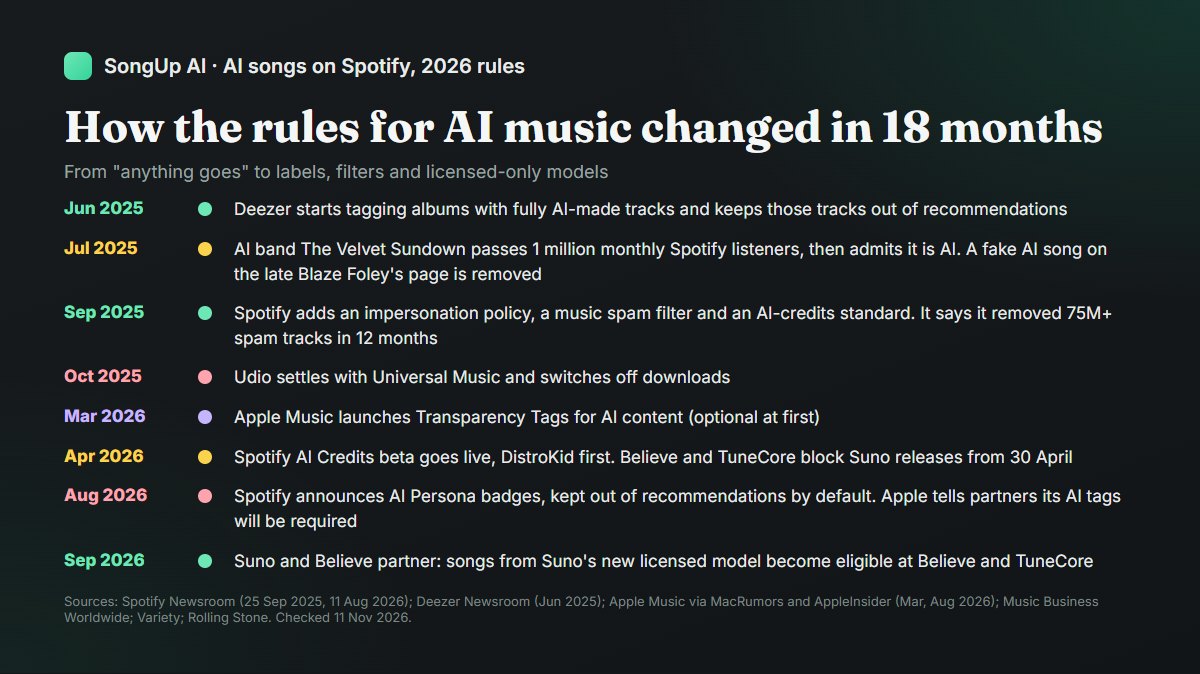
- Music spam filter. Spotify's filter tags uploaders and tracks that use spam tactics and stops recommending them. Spotify names mass uploads, duplicates, SEO tricks in titles and artificially short tracks. It said it had removed more than 75 million spammy tracks in the previous 12 months.
- AI disclosures. Spotify helped build an industry standard through DDEX, the body that sets the format of music metadata, so a release can say which parts used AI: vocals, instrumentation, post-production. Spotify says it will not penalize or down-rank tracks that disclose AI use.
The two labels (2026):
- AI Credits went live as a beta on 16 April 2026, with DistroKid as the first distributor sending them. They appear in Song Credits on the mobile app, only when the artist discloses through their distributor. Spotify notes that a missing credit doesn't prove AI wasn't used (Music Business Worldwide).
- AI Persona badges were announced on 11 August 2026 and began appearing in mid-September. The badge marks an artist whose public identity is AI-generated and isn't a real person. Artists can self-disclose, and Spotify also reviews profiles that appear to use photorealistic AI identities, starting with those above an audience threshold. By default, AI Persona profiles are left out of editorial and algorithmic recommendations; their music reaches people who follow them.
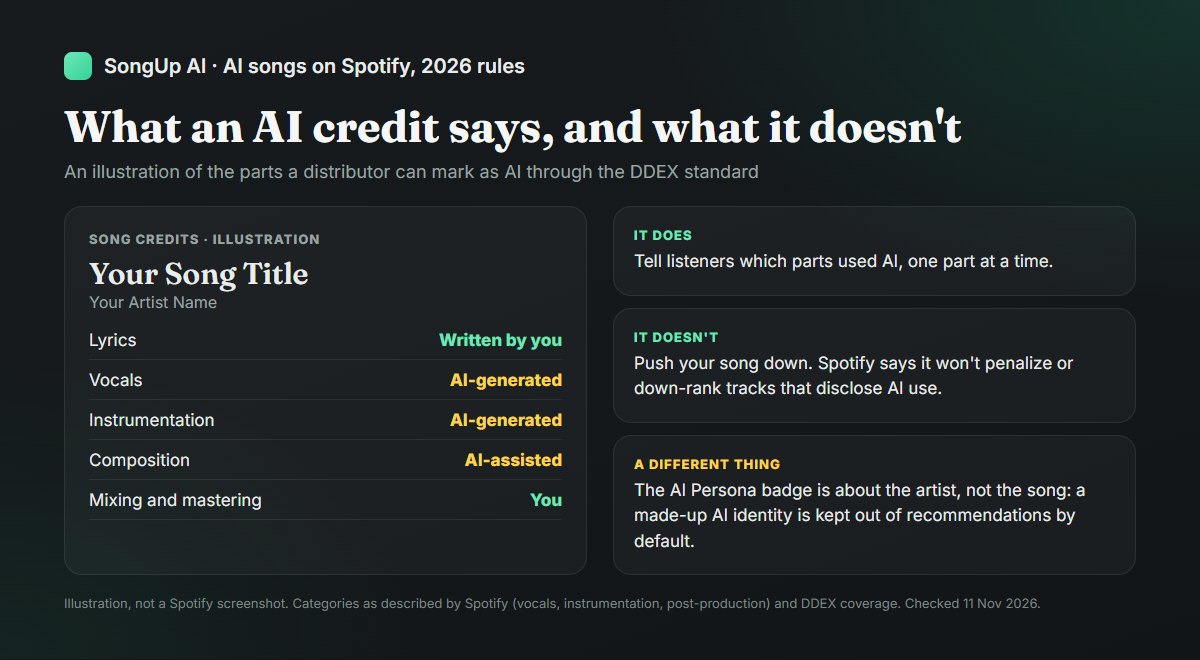
The difference that matters
An AI credit describes the song. An AI Persona badge describes the artist.
Saying "AI-generated vocals" in your credits doesn't hurt your reach. Inventing a photorealistic singer who doesn't exist and presenting them as real does: that profile can be badged and kept out of recommendations. If you're a real person releasing songs made with AI, use your own name or an honest project name, and disclose what AI did.
You can't upload straight to Spotify: what distributors allow
Spotify doesn't accept uploads from individuals. Every independent release reaches it through a distributor, which delivers the audio and the metadata to Spotify, Apple Music, Amazon Music, Deezer, TikTok and the rest. That makes the distributor's AI policy the first real gate, and the three biggest ones now disagree.
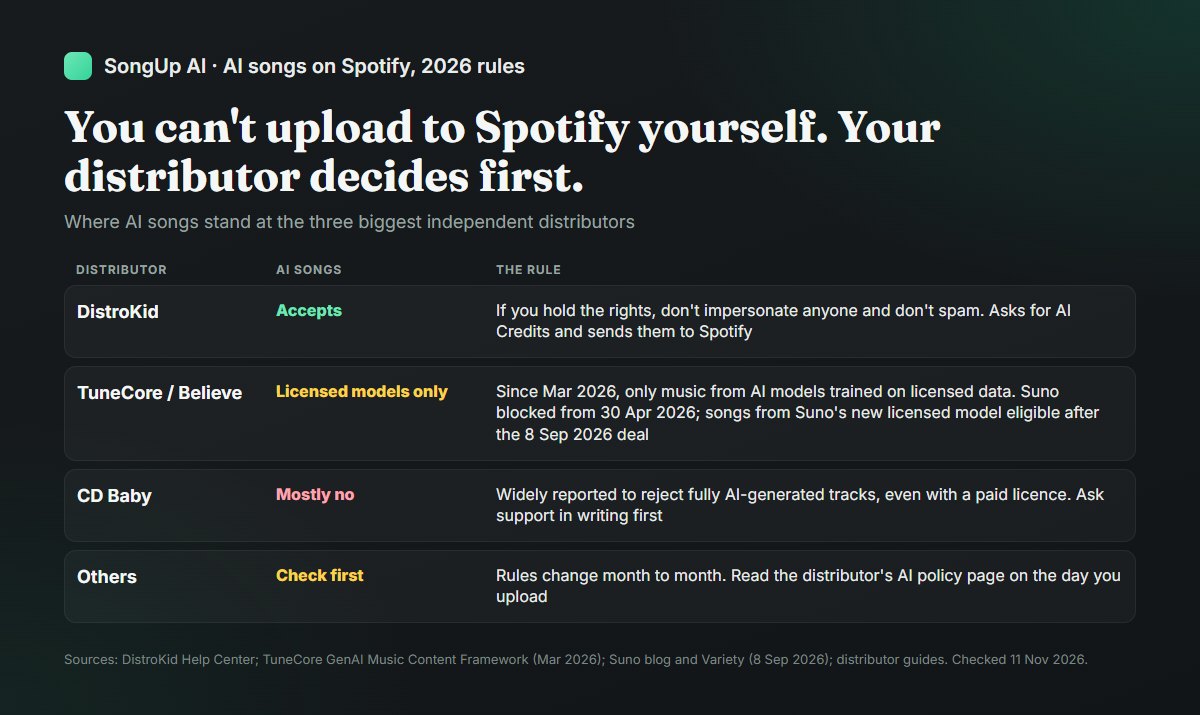
| Distributor | AI songs? | The rule (checked 11 Nov 2026) |
|---|
| DistroKid | Accepts | AI music is accepted when you hold the rights, don't impersonate anyone's voice or identity, don't spam, and don't infringe anyone's rights. It asks for AI Credits and passes them to Spotify. |
| TuneCore (Believe) | Licensed models only | Its GenAI Music Content Framework (March 2026) allows only music made with AI models trained on fully licensed data. Believe blocked Suno releases from 30 April 2026. Since a deal announced on 8 September 2026, songs from Suno's new industry-partner model are set to become eligible, but songs from Suno's older models are not. |
| CD Baby | Mostly no | Widely reported to reject fully AI-generated tracks, even with a paid licence from the AI tool. The details are disputed between sources, so ask CD Baby support in writing before you pay. |
Two warnings apply to all of them. First, a distributor saying yes doesn't bind the store: DistroKid itself warns that Spotify and others can still remove a track under their own rules. Second, these pages change. TuneCore's policy went from open to blocked to partly reopened within six months. Read the distributor's AI page on the day you upload, not a blog post from last spring, this one included.
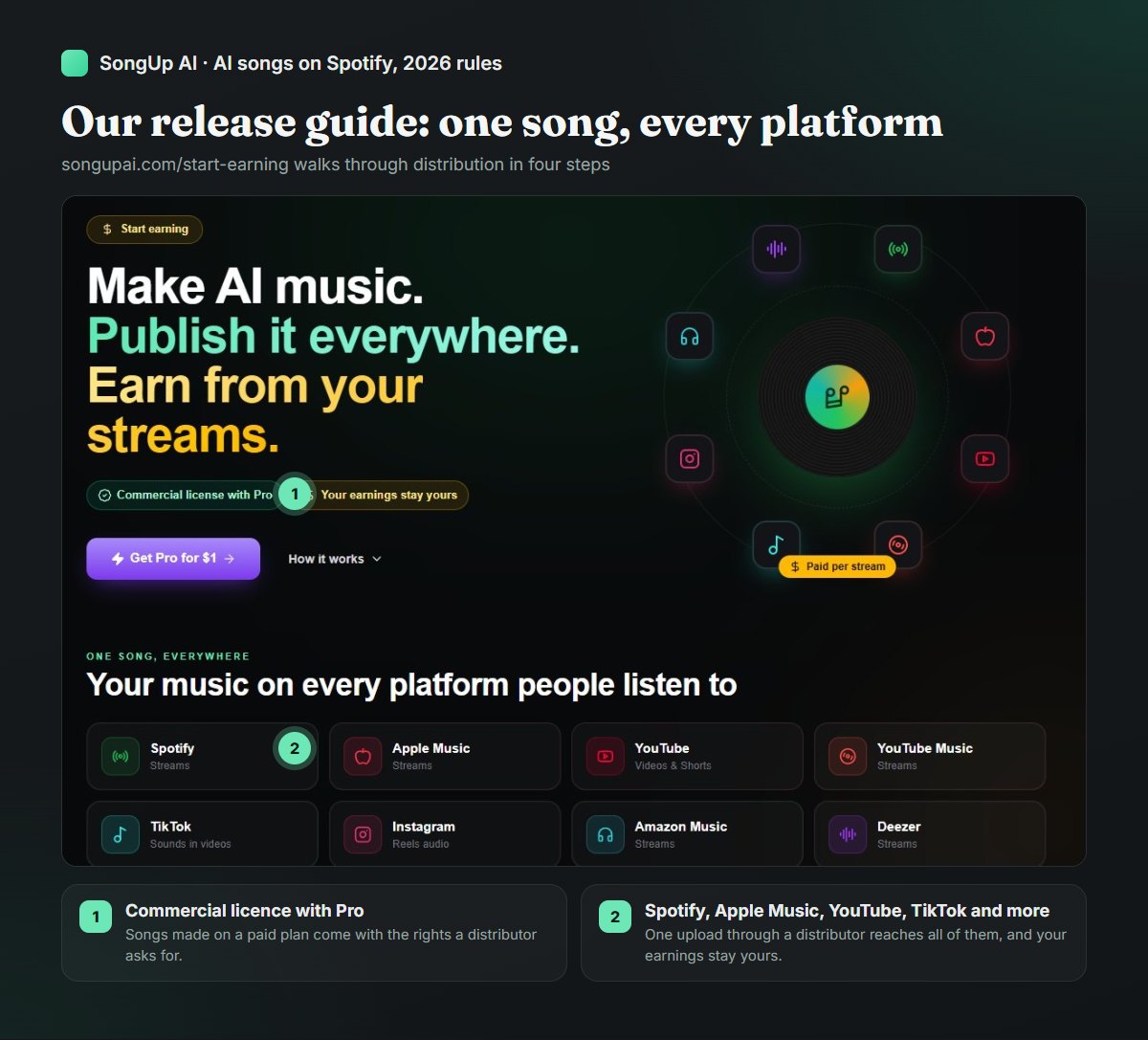
For the full walk-through of choosing a distributor and filling in a release, see how to make money with AI music, which takes you through the upload screens step by step, or the four-step summary on our Start Earning page.
This is the check people skip, and it's the one a distributor or a takedown claim will ask about. Your AI tool's terms decide whether you're allowed to sell, stream and monetize what it made, and the answer usually depends on your plan.
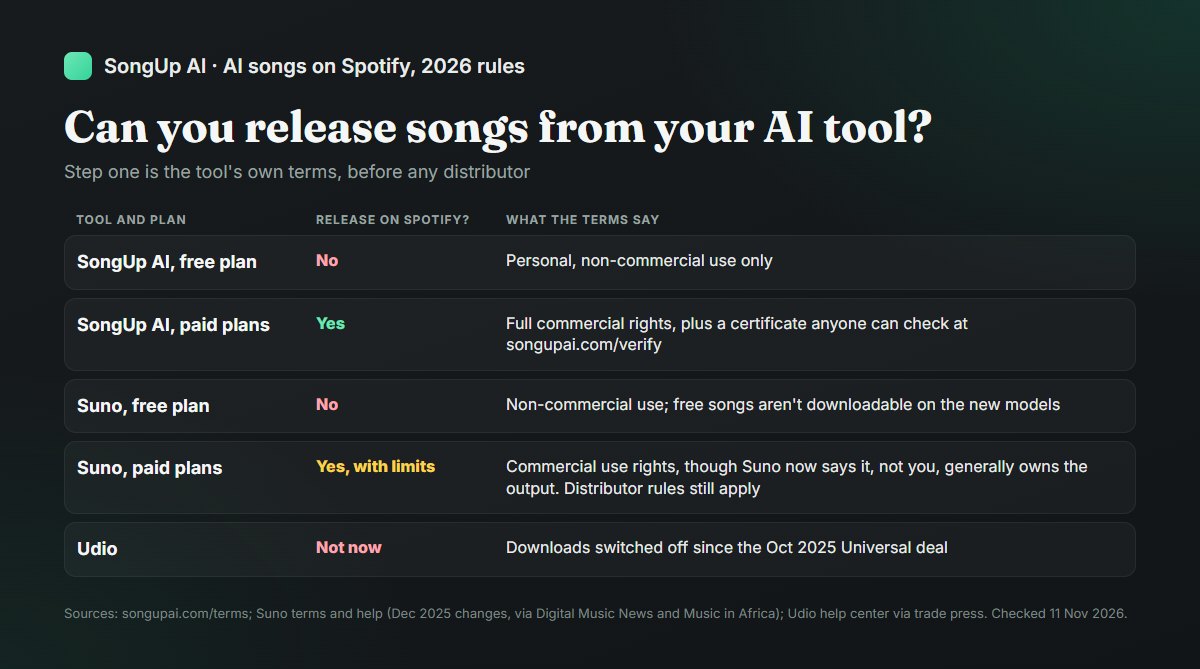
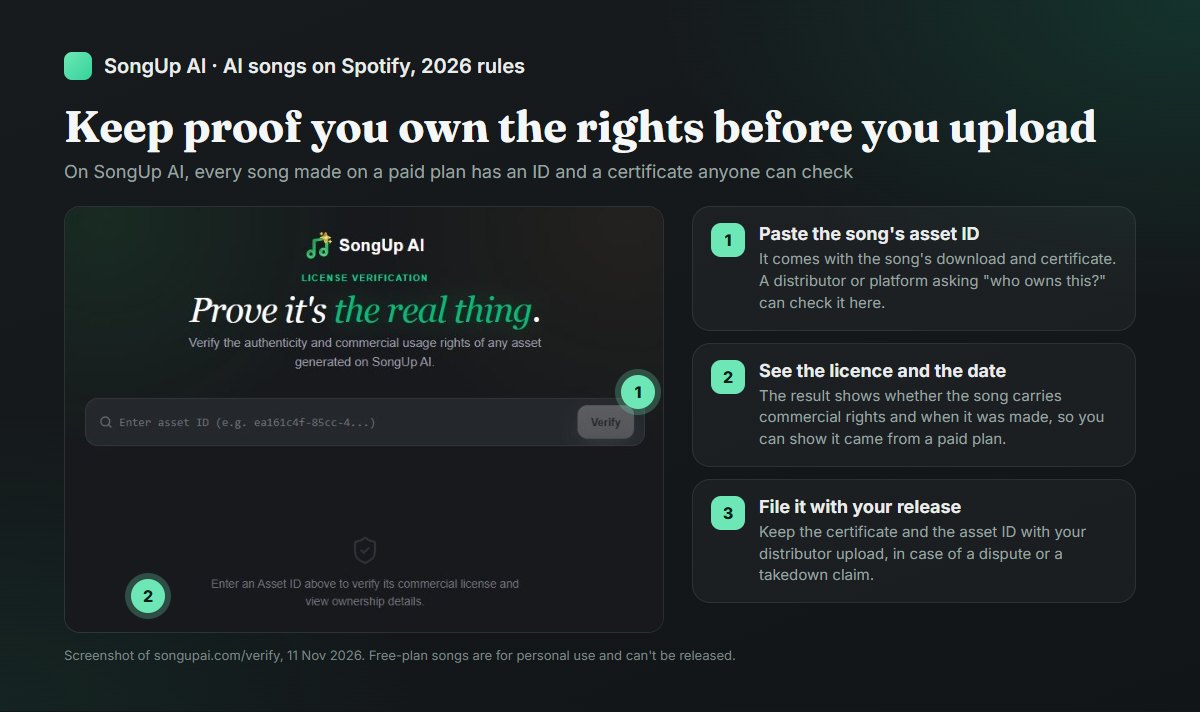
- SongUp AI. Songs from the free plan are for personal, non-commercial use, so releasing them breaks our terms. Songs made on a paid plan, or bought on their own, come with full commercial rights, and each one has a certificate of ownership anyone can check at songupai.com/verify. See our plans.
- Suno. Free-plan songs are non-commercial. Suno's December 2025 changes, made after its deal with Warner Music, also stopped free songs from being downloaded on its new models (Digital Music News). Paid plans grant commercial use rights, but Suno's updated terms say Suno, not you, is generally the owner of what it generates (Music in Africa). Then the distributor question applies on top: TuneCore only accepts songs from Suno's new licensed model. We compare the two services in SongUp AI vs Suno.
- Udio. After its settlement with Universal Music in October 2025, Udio switched off audio, video and stem downloads. Without a file, there's nothing to send a distributor. Our Udio alternative page covers what changed.
Rights and copyright are different questions, though. A tool can hand you every right it has, and the US Copyright Office can still refuse to register a song made entirely by AI. We cover that in AI music copyright and commercial use, and what each tool's licence actually allows in AI music commercial licences compared.
Do this before you upload
Save proof of your rights with every release.
Keep the plan you were on when you made the song, the date, and any certificate or licence page. If a distributor flags your track or someone files a claim, that's what you'll be asked for. A screenshot of a terms page you read months later won't prove what the terms were on the day.
Is AI music allowed on Apple Music, Deezer, YouTube and TikTok?
Your distributor sends the same song to every store, so it helps to know how the others treat AI. All of them allow it. They differ on labels and on how far an AI song can reach.
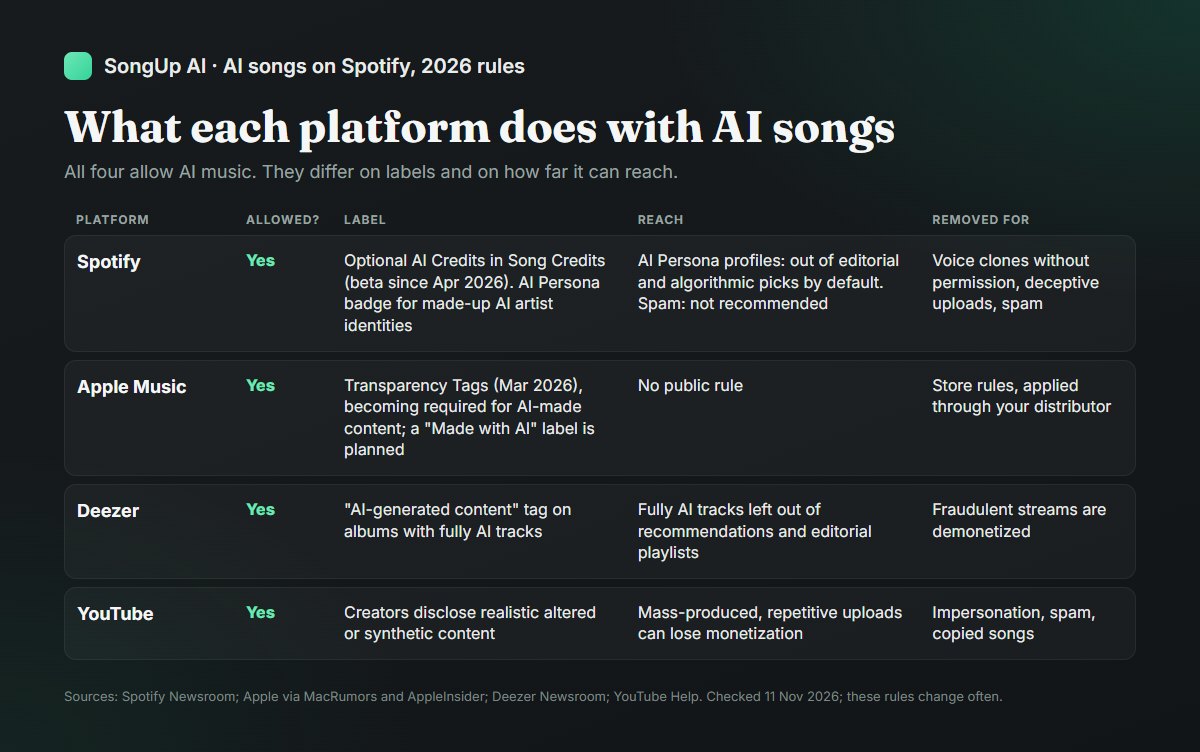
- Apple Music launched Transparency Tags on 4 March 2026, covering the track, the composition, the artwork and the music video (MacRumors). They started as optional. In August 2026 Apple told partners they will be required when AI made a material part of the content, and that listeners will see a "Made with AI" label (AppleInsider). Your distributor sends these tags, so answer its AI questions honestly.
- Deezer detects fully AI-generated tracks itself. Since June 2025 it has tagged albums that contain them, and it leaves fully AI tracks out of its algorithmic recommendations and editorial playlists (Deezer). It also demonetizes streams it finds fraudulent. We track how many AI tracks reach Deezer each day in our AI music statistics.
- YouTube asks creators to disclose realistic altered or synthetic content when they upload (YouTube Help), and its Partner Program doesn't pay for mass-produced, repetitive uploads, which it calls "inauthentic content" (YouTube Help). A song you release through a distributor also reaches YouTube Music.
- TikTok and Instagram get your song as a "sound" people can use in their videos. TikTok asks creators to label realistic AI-generated content (TikTok Support).
What gets AI songs removed from Spotify
Almost every AI song that gets pulled breaks one of these rules. None of them is "it was made with AI".
| What happened | Why it's removed | Real example |
|---|
| An AI voice that copies a real singer | Unauthorized vocal impersonation | Spotify's September 2025 policy bans it outright |
| An AI song delivered to a real artist's profile | Deceptive content, misattribution | In July 2025 an AI track appeared on the page of country singer Blaze Foley, who died in 1989. Spotify removed it (The Fader) |
| Dozens of near-identical tracks | Spam: duplicates and mass uploads | Part of the 75 million tracks Spotify removed in 12 months |
| Very short tracks repeated to farm plays | Spam: artificially short tracks | Named in Spotify's spam filter |
| Paid "streams" or bot playlists | Artificial streaming | Spotify charges labels and distributors per track when it detects it, and distributors often close the account |
| Artist name or title stuffed with search terms | Spam: SEO tricks in metadata | Named in Spotify's spam filter |
What doesn't get you removed is success. The AI band The Velvet Sundown passed a million monthly listeners in July 2025 and then confirmed it was an AI project (Rolling Stone). Its music stayed up. Under the 2026 rules, a profile like that is exactly what the AI Persona badge was built for, which shows the direction things are moving: AI songs are allowed, but pretending an AI singer is a real person is going to cost you reach.
How to upload an AI song to Spotify, step by step
Here is the order that avoids every problem above. The distributor's own upload screens are covered in detail in our AI music income guide; this list is the preparation that decides whether the release stays up.
- Make the song on a plan that allows release. On SongUp AI that's any paid plan or a song bought on its own. Note the date and keep the certificate.
- Write the words yourself if you can. Lyrics you wrote are your own work, and they make your human contribution clear. Our AI song prompts guide shows how to describe the song you want.
- Finish the audio. Check the levels and the ending. Streaming services turn loud tracks down, so master to about −14 LUFS: our guide to mastering a song explains how, and the AI mastering tool does it in a minute.
- Pick a distributor that accepts music from your tool, using the table above, and read its AI page that day.
- Use an artist name that's yours. Search Spotify first so you don't land on another artist's profile. Don't use a real artist's name, or a "feat." you don't have.
- Fill in the AI questions honestly. Mark which parts used AI. On Spotify this becomes an AI credit, which won't lower your ranking. Hiding it can count as deception later.
- Use cover art you have the rights to. Apple's tags cover artwork too, so disclose AI art the same way.
- Release one song properly, not twenty at once. Set a date at least seven days out so you can pitch it to Spotify's editors from Spotify for Artists.
- Grow it with real listeners only. Never buy streams or playlist spots.
Here's what a finished release sheet looks like for a song made on a paid SongUp AI plan, with lyrics written by the artist:
| Field | What to enter | Why |
|---|
| Track title | The song's real name only | No "AI", "free" or keywords in titles: that's an SEO trick the spam filter looks for |
| Primary artist | Your name or your own project name | Never a real artist's name; avoid a photorealistic fake persona |
| Songwriter / lyricist | You, if you wrote the lyrics | Shows your human contribution |
| AI credit: vocals | AI-generated | Honest disclosure; doesn't affect ranking on Spotify |
| AI credit: instrumentation, composition | AI-generated or AI-assisted | Matches how the song was made |
| Mixing and mastering | You, or "AI-assisted" if a tool did it | Some distributors don't count AI mastering as AI content; follow their form |
| Cover art | Your own image, or disclosed AI art | Apple's tags cover artwork too |
| Rights proof | Paid plan, creation date, certificate or asset ID | What you'll need if the track is flagged |
| Release date | At least 7 days ahead | Time to pitch to Spotify's editors |
Do AI songs make money on Spotify?
They earn under exactly the same rules as any other song. Spotify pays from listener engagement, and since 2024 a track has to reach 1,000 streams in the previous 12 months to earn royalties at all. So the AI part changes nothing about the money. What changes it is the reach: on Deezer a fully AI track won't be recommended, and on Spotify an AI Persona profile won't be either.
The honest takeaway from the numbers is that uploading a lot of AI songs doesn't pay. In our AI music statistics, AI tracks are about half of Deezer's daily uploads but only 1% to 3% of its streams. Songs that earn are the ones people save and come back to: a clear style, a real audience, a release people are told about. Our AI music income guide covers per-stream rates and the other ways creators earn, from sync licensing to custom jingles.
Should you label your song as AI?
Yes. Spotify's AI Credits are optional, but disclosure costs you nothing there: Spotify has said it won't penalize or down-rank tracks for it. Apple Music is moving to required tags, and Deezer detects fully AI tracks whether you say so or not. Labeling honestly now means you don't have to fix your metadata later, when the rules tighten again.
What matters more is not presenting an AI identity as a real person. A real artist who discloses "AI vocals" keeps their reach. A made-up singer with an AI-generated face and a fake backstory is what Spotify's AI Persona review looks for.
Release-ready from the first song
Your words, your song, your rights
On a paid SongUp AI plan, every song you make from your own description comes with commercial rights and a certificate you can show a distributor. Write the lyrics yourself or let us draft them, in more than 70 languages.
Can you upload AI songs to Spotify: FAQ
Does Spotify ban AI-generated music?
No. Spotify says it treats all music equally regardless of the tools used to make it. It removes unauthorized voice impersonation, spam and deceptive uploads, whether or not AI made them.
Can Spotify detect AI music?
Spotify hasn't published a detector. It relies on disclosures from distributors, its spam filter and reviews of suspicious profiles. Deezer does run its own detection tool and tags fully AI-generated tracks, and some distributors screen uploads too, so assume AI use will be noticed and disclose it.
Can I upload Suno songs to Spotify?
Only if you made the song on a paid Suno plan, and only through a distributor that accepts Suno music. DistroKid accepts AI songs you hold the rights to. TuneCore and Believe accept only songs from Suno's new licensed model, not from its older models. Free-plan Suno songs are non-commercial.
Can I upload a song made on a free AI plan?
Usually not. Free plans, including SongUp AI's and Suno's, are for personal, non-commercial use. Releasing those songs breaks the tool's terms, even if a distributor accepts the upload.
Do I have to label AI music on Spotify?
Not on Spotify itself: AI Credits are optional, and disclosing doesn't lower your ranking. But your distributor may ask, Apple Music is making its AI tags required, and Deezer tags fully AI tracks automatically. Answer the AI questions honestly.
Do AI songs get royalties on Spotify?
Yes, on the same terms as other songs: a track must reach 1,000 streams in 12 months to earn, and artificial streams are not paid and can get the track removed.
Can I use an AI voice that sounds like a famous singer?
No. Spotify allows vocal impersonation only with the impersonated artist's permission, and an unauthorized clone gets removed. Describing a style is fine ("warm soul vocal", "90s pop"); copying a real person's voice is not.
Can I copyright a song made with AI?
The parts you wrote yourself, such as the lyrics, can be protected. The US Copyright Office won't register material generated entirely by AI. A tool's terms can still give you the right to release and earn from the song. Our guide to AI music copyright and commercial use explains the difference.